Tuesday, May 18, 2010

Baruti Kafele: a Principled Principal

Newark's Principal Kafele:  
Transforming Mis Education Into Quality Education


Greetings family,

The Milken Family Foundation spent a day at Newark Tech filming a few months back.  Check out the short clip.  After 9 hours of filming, the following clip is the finished product.  Hope you like it.

I might add that I am EXTEREMELY proud of our State Standardized test results for juniors which were released last Friday – 93% of our students were proficient in Language Arts and 82% in math.  This is truly phenomenal!  I might also add that for our seniors, after retakes of the test, 100% passed Language Arts and 88% passed math.  Kudos to the Newark Tech staff and students for a job well done!


Principal Kafele

"I'm on FIRE!!!"

Author – Motivating Black Males to Achieve in School and in Life
http://www.principalkafele.com


--------------------------
BIO--


Principal Baruti Kafele, whose African first name means "teacher" is on a personal mission to motivate, educate and empower teachers, counselors, administrators and parents of Black and Latino children the world over.
As an educator, Principal Kafele has excelled in the capacity of teacher and principal. As a teacher in East Orange, NJ, he was selected as the East Orange School District and Essex County Public Schools Teacher of the Year. He was also selected for Who’s Who Among America’s Teachers six times. As a principal, he led the transformation of four different New Jersey public schools, including his current school, “The Mighty” Newark Tech, which has been recognized twice by U.S. News and World Report Magazine as one of America's best high schools.
As a writer, Principal Kafele is the author of five books which include:  A Handbook for Teachers of African American Children, A Black Parent’s Handbook to Educating Your Children (Outside of the Classroom), and his new best seller, Motivating Black Males to Achieve in School and in Life. 
As a speaker, Principal Kafele is on fire!  He has "fired up" countless audiences with his empowering message of "extraordinary achievement" for over twenty years. He conducts professional development workshops for educators at major national conferences and school districts throughout the U.S. regularly. He also conducts parenting workshops, male empowerment seminars and student motivational assemblies in addition to his empowering keynote addresses.
As a family man, Principal Kafele is happily married to his wife Kimberley and is the proud father of his three children, Baruti, Jabari and Kibriya.
Finally, Principal Kafele earned his B.S. degree in Management Science/Marketing from Kean University and his M.A. degree in Educational Administration from New Jersey City University. He is also the recipient of numerous educational, professional and community awards, including the prestigious Milken Family Foundation National Educator Award in 2009 and the City of Dickinson, Texas proclaiming February 8, 1998 as "Baruti Kafele Day!"

Sunday, May 16, 2010

ED Cartoon of the Week

"Race to the Top" Is Bottoming Out
================

Protesting Black Cleveland Hi School Youth Get Red-Baited by Corporate Media
  
NOTE: It is becoming clearer everyday that our fight for a free quality public education for all New Yorkers is not a lonely battle. From Puerto Rico to Los Angeles to Cleveland, students, educators, parents and communityfolk are resisting the cutbacks, charterizing and criminalizing of our youth. Here is just one example of the growing resistance movement....

NOTE: This video is visually shaky but has a decent audio.


ClevelandFIST — May 15, 2010 — This video shows students from Collinwood High School gathering in a crowd of several hundred chanting save our schools! Later, Martha Grevatt is shown responding the media attempts to claim the protest was part of Caleb Maupins communist agenda. 

Devin Branch, a local organizer with the October 22nd Coalition, is seen engaging in a discussion with a leader of the local SEIU. Devin Branch says "I am ready to accept a level of disorganization the part of the youth to make up for the lack of militancy and the complacency of the adults." 

Devin Branch makes it clear that he feels the attacks on local Marxists and Cleveland FIST for supporting the student led protest are hypocritical, when NAACP and other forces ignored the students demands and have done very little to stop the destruction of the Cleveland Public School system.

•  Call
the Fifth District Police station, 216-623-5618 & 216-623-6500 to demand all charges against the students be dropped and to protest the brutal treatment of the students. 

•  Call the Cleveland Board of Education, 216-574-8000 and Collinwood High School, 216-451-8782 to demand the suspensions be rescinded and that Seth Barlekamp not be threatened with expulsion.

http://www.clevelandfist.blogspot.com
http://www.fistyouth.org
http://www.workers.org


Tuesday, April 27, 2010

NYC Charter School Teachers 
Back Off From Union! 

FROM: David Galarza


April 27, 2010

By JENNIFER MEDINA

Charter schools came under a harsh spotlight last week, with State Senator Bill Perkins holding his long-awaited hearing in an attempt to examine how the privately operated schools spend their public money. The hearings prompted several articles in the papers exploring potential conflicts of interest and other practices that have raised the ire of critics — and the issues are not limited to New York. And The New York Post took on Mr. Perkins with zeal in its editorial pages.
But as the public clashes raged, a quieter battle began coming to an end.

Just a year after voting to join the United Federation of Teachers, staff members at KIPP AMP Academy Charter School in Crown Heights, Brooklyn, voted to rescind the decision to sign up with the city’s teachers’ union. The petition to break from the union was filed Wednesday afternoon with signatures from 16 staff members, including one dean of the school, an office manager and an operations manager, as well as several teachers.

To explain technical matters: The staff members are asking the Public Employment Relations Board to decertify the United Federation of Teachers as their collective bargaining representatives.

The split appears to be a loss for the union, which has put an emphasis on creating chapters at existing charter schools. Teachers at charter schools tend to work longer — 12- or even 16-hour days are not unusual — and do not have the job protections the unions provide.

The U.F.T. will fight the decision with the Public Employment Relations Board by suggesting that the teachers were intimidated by management and that a group of teachers is still committed to joining the union.

Negotiations between the union and KIPP management had been quietly plodding along for months, though there was no indication that they were anywhere near an agreement. But for now, all negotiations will halt.

Unlike many of the fights over charter schools, the battle over the union at KIPP has been relatively quiet — few advocates on either side have drawn attention to it as they did with a battle in Baltimore, where the KIPP school shortened the length of the day and eliminated Saturday classes.

Lyle Zuckerman, a lawyer for the teachers who filed the petition, said that none of the teachers were willing to speak to a reporter about the matter, in part because of the union’s suggestion that it intends to fight in court.

Mr. Zuckerman said that the guidance counselor leading the charge to decertify the union, Dameon Clay, told him that the school’s administration had changed in the last year and that the current staff has an excellent and trusting relationship with them.

“We think that we can deal with them directly without a third party, and that would be best for the staff and our students,” Mr. Clay said in a statement provided by Mr. Zuckerman. “The staff and the administration know our students well, we know the parents well, and we know firsthand what’s in their best interests.

“As for personnel matters,” the statement continued, “we’re confident that we can deal with the administration directly as advocates for ourselves. We trust that the new administrators will deal with us fairly.”

When the teachers moved to join the union last year, several of them cited high teacher turnover as a reason for their worry. This year, roughly half the teachers at the school were also at the school last year. Several teachers who joined the effort to form the union last year signed the petition to remove themselves from it last week.

Last year, one teacher changed her mind about joining the union fairly quickly, saying that she came to believe the union would do more harm than good for the teachers.

So what happens next at the school? First, the state’s labor relations board would have to approve the decertification petition. If that happens, the teachers at the school will vote on whether they want to join the union.

Unions are generally anathema to charter school operators, who say they thrive on flexibility and creating their own culture at schools. And so the unions and charter school advocates are seemingly engaged in a open warfare in New York City, where Mayor Michael R. Bloomberg and Chancellor Joel I. Klein have embraced them with open arms.

But in Albany, negotiations continue over plans to increase the cap on charter schools — currently at 100. Mayor Bloomberg and other advocates want it raised significantly or lifted entirely, which they say would give the state a better shot at millions of dollars from the competitive federal education grant known as Race to the Top. Needless to say, there are more battles to come.
-----------------------

Every Tuesday, education beat reporters for The New York Times take you inside the New York City school system. 

Have a tip? Send it to IntheSchools@nytimes.com.
-----------------------
Senator Bill Perkins Fights The Charter School Bumrush in Harlem!


Monday, April 26, 2010

Video Excerpts from NY State Senator Bill Perkins Hearing On Charter Schools

As the BloomKlein Cabal proceeds to ram as many charter schools into Black and Latino community schools, there is mounting opposition growing not only from parents, students and educators in all the invaded noncharter schools, but mounting opposition is also growing among charter school parents. They are slowly but surely recognizing the hype they have been hoodwinked into believing. You will see some of this in these video excerpts from the 22 April 2010 hearing. 

The commentary that introduces each of the four video excerpts was written by education activist Norm Scott. These video excerpts were provided by Norma Scott
----------

Lydia Bellahcene, Parent PS 15K. Lydia was there all day - from even before I arrived at 10- with her young child, who just may be the best behaved child I have ever seen in my life. Lydia makes an awesome presentation here. I've gotten to know her through PAVE and she never ceases to amaze me. That the actions of BloomKlein have led to activating her and people like her is a sign of their ultimate failure.


-------------------

Khem Irby, Parent District 13, Brooklyn- another awesome parent advocate. Khem is always there for everyone. She makes a statement for Leonie and for herself.


---------------------
Sonia Hampton, Parent PS/MS 149, Harlem. This is the first time I've seen Sonia and my mouth fell open at her testimony. I wanted her to go on forever.


--------------------------
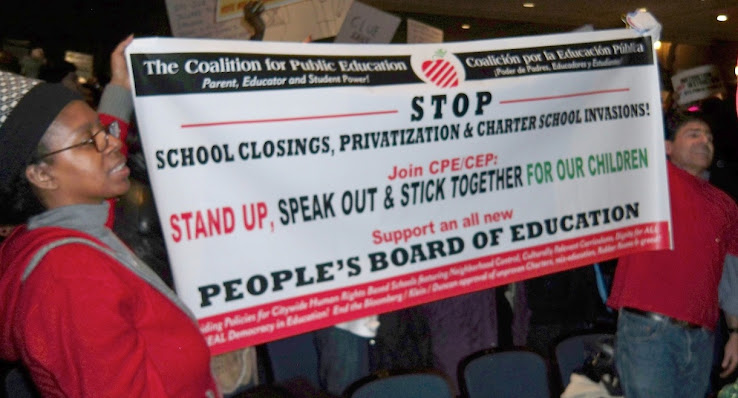
Bill Hargraves and Akinlabi Mackall do a lot of community organizing in a number of spheres including the Coalition for Public Education, which has been exploring opportunities to work together with GEM.


Commentary from Norm Scott: 
These parent and community voices have been so strong and it's been a pleasure getting to know them over the past year. Ed Notes has often been looked at as a voice for teachers. But since I began teaching I had the utmost respect for many of the parents I met. I can honestly say I had fantastic relationships with the parents of the kids in my class. I worked very hard at it. The first day of school I gave them my phone number (see KIPP, we did it 40 years before you). That built trust and helped enormously, though they rarely called. Kids were very rarely able to divide me from their parents or use them against me. It had a big impact on their behavior and created an extremely positive climate for all of us. Teachers must find ways to create links to parents, both educationally and politically. Without a joint alliance, the forces of BloomKlein and neoliberalism, which has a basic aim of sowing divisions, win out.

I started a new you tube channel - ednotesonline - and future videos will no longer be listed under norscot2, though you can still access the 77 videos I already posted there. Other videos will be posted at the GEMNYC you tube channel.

If traffic gets too heavy for all these videos and slows up the blog, let me know and I will pull them and leave just the links to you tube.

All videos must be 10 minutes so I had to do some trimming to get them in. So if you see yourself and a bit is missing that is why.

Coming in next batches: Magnificent Mona and cohort charter school parents rake over charter school operators, followed by the John White interrogation on how charter schools get parent info.

Tuesday, April 20, 2010

FIRED-UP SPEAKERS 
IN DEFENSE OF A PUBLIC PS123
----
And GRITTV Newspiece on NYC's Segregated School System 

  ooooooooooooooooooo
Monday April 12, 2010 

Brother Angel says:
<<"PS 123/Harlem Success hearing: April 12, 2010
I was at the rousing PS 123/Harlem Success invasion hearing on Monday April 12 and it's been wonderful to see this Harlem school community get themselves organized. The teachers and parents did an amazing job. They even had posters made up of the Klein/Moskowitz letters. GEM has been involved since the end of the last school year and was there with our banner this time too. ..."
>>


Saturday, April 17, 2010

COULD THIS ALSO BE TRUE IN NYC SCHOOLS?

Students Don't Learn More Science Under Chicago Public Schools
College-Prep-for-All Policy
Get the report at: http://news.uchicago.edu/images/pdf/100312.ccsr-report.pdf


THE University of Chicago education newspiece was interesting, but not surprising. What I have to say isnothing really new, nor is it specific only to the sciences, but I've long felt that the problem lies in the way sciences are taught -- and I'm guilty as charged, in my own educational practice. In my experience, science tends to be taught like a language (and not even good language-teaching), flooding the students with a wealth of vocabulary, concepts and factoids, which are illustrated with examples, supplemented with cookbook labs and enriched with "projects." This type of science education becomes even more pronounced when we are forced to teach to tests. I did this for much of the decade I taught high school science, and have continued in this mode as an adjunct for most of the past decade, in both cases with exceptions I will mention.

This is not science education, and it is not science. In fact, it is the antithesis of science. To me, science is about creative inquiry into the laws of motion of the natural world. At least, that's why I decided to do graduate work in biology. But, if the powers that be were really interested in teaching SCIENCE, that's how courses, from the most basic on up, would be designed. Labs wouldn't be add-ons, rather, courses would be built around practical and real inquiry. This obviously wouldn't work with a one-size fits all, standardized curriculum.

I had the opportunity to work with undergraduate and high school interns in my lab at the museum of natural history. In just a few weeks over the summer -- for the undergrads -- or a semester -- for the high school kids -- students gained a depth of understanding of those concepts that I had never achieved in a classroom. More importantly, they were fired up, taking initiative and actively asking questions and following leads.

This type of science education is not for everyone. Presumably most students (most of us) are not particularly interested in scientific research, although I believe all students should be required to experience one course of this type. But most people are interested in science insofar as it touches their lives in other ways. Health, the environment, literature, art, social concerns. So, for me, the other way to teach science is also based on inquiry, but contextualized. Here, the parallel with learning a language the RIGHT way is striking: Freire's praxis -- "reading the word to read and change the world."

Perhaps the classroom course I taught in which high school students achieved the greatest sophistication of understanding of such basic scientific concepts as pH, natural cycles, food chains, etc., was a semester-long class on environmental health/racism that the students and I thrashed out together. The focus of the class was a medical waste incinerator in the South Bronx, where most of the students lived.

Another illustrative experience was an HIV/AIDS peer-education group we started at Seward Park High School, when I was HIV/AIDS coordinator (when such things were allowed to exist). In this case, not only was the subject up close and personal for many of the students, but they were the teachers. One student in the group, Luis, was the oldest of five siblings in a family in which his mom was the only caregiver, and she was dying of AIDS. Luis was the recognized leader of the group and the best educator. And, he went on to study cell biology.

If ObamaDuncanBloombergKlein want to promote the sciences, they'd better rethink their entire educational paradigm, from the bottom-up. But, of course they want to promote the sciences only for some, while continuing to mystify them -- and their practitioners -- for the masses.

Michael Friedman, Ph.D.
City University of New York

Sackler Institute for Comparative Genomics
American Museum of Natural History
79th Street and Central Park West
New York, NY 10024
Office: 212-313-8721
Cell: 718-812-4246

vnvnvnvnvnvnvnvnvnvnvnvn

Research concludes that students don't learn more science under Chicago Public Schools College-Prep-for-All Policy

March 15, 2010
news.uchicago.edu/news.php?asset_id=1903


A Chicago Public Schools policy that dramatically increased science requirements did not help students learn more science and actually may have hurt their college prospects, according to a new report from the Consortium on Chicago School Research at the University of Chicago.

The science policy was part of a larger CPS initiative to expose all students to a college–preparatory curriculum by increasing course requirements across a range of subjects.

Though CPS high school students took and passed more college–prep science courses under the new policy, overall performance in science classes did not improve, with five of every six students earning Cs or lower. College-going rates declined significantly among graduates with a B average or better in science, and they dipped for all students when researchers controlled for changes in student characteristics over time.

The report, "Passing Through Science: The Effects of Raising Graduation Requirements in Science on Course–taking and Academic Achievement in Chicago," has significant implications for districts across the country considering requiring a college–preparatory curriculum for all students. In 2009, 21 states required all students to take four years of math and a minimum of three years of science to graduate high school. These policies were a response to long–running concerns that American students are falling behind their peers on international tests, particularly in math and science. Most recently, President Obama announced a major new public–private initiative designed to increase student engagement in Science, Technology, Engineering and Math.


CPS was at the forefront of the movement to require a college–preparatory science curriculum for all. In 1997, CPS mandated that all incoming ninth–graders take three years of college–preparatory science coursework. This policy change occurred several years before many states raised their science requirements and eight years before the state of Illinois instituted a more modest increase.

To examine the effect of the policy change, the CCSR report compares academic outcomes for cohorts of students in Chicago before and after the 1997 policy switch. 

Key findings from the report include:

* The new curriculum policy ended low expectations for science coursework. Two years before the policy change, less than half of CPS graduates passed three or more college–prep science courses; most did not complete more than one. Immediately after the change, almost all graduates passed at least three full–year science classes.
* Most graduates received a C average or lower in science, which was similar to the performance of graduates before the policy change.
* Because of policy's structure, students were less likely after the policy to take both physics and chemistry, a combination that is common for students aspiring to college nationally.
* Graduation rates declined by four percentage points in the first year of the policy and another percentage point in the next year, after accounting for changes in the backgrounds and prior achievement of students entering CPS high schools.
* College enrollment did not increase under the new policy; nor did college persistence (students were no more likely to stay in college for at least two years).

Get the report at: http://news.uchicago.edu/images/pdf/100312.ccsr-report.pdf

Monday, April 12, 2010

English Language Learners Get Their Tongues Tied By BloomKlein

Commentary:

At the heart of this news article on New York City Public Schools' failure to provide legally mandated instructional services to thousands of English language learners is the State's constitutional obligations to protect the civil rights of a protected class of students (LEP/ELL student) as per federal, state and court mandates.


Based on information available from the New York State Education Department:

http://www.emsc.nysed.gov/biling/bilinged/2009-10_NYC_Part154-LAPReports.htm


New York City District Data  for 2008-2009 
in Aggregate for all districts


(minus all the high schools except alternate high schools)

The question is not whether ELL graduation rates are improving. The question is whether ELL students are being properly identified, properly placed in either ESL or TBE programs (i.e., provided appropriate instructional programing) by ceritified, qualified teachers.

The District summaries re LEP/ELLs show significant deficiencies in a number of districts; and indicate systemic issues of lack of reporting (Language Allocation Policy documents) in 675 schools in New York City as of December 19, 2009 and an alarming number of  LEP/ELLs (10,077) not accounted for by Districts in their submitted documents.

The large number of ELLs not served (8,000+) and the large number of ELl enrolled in ESL only classes who should be in Transitional Bilingual Education (TBE) classes, as well as the 15% of ELLs who are long-term ELLs (more than 6 years identified as ELLs and still eligible) are cause for great concern and for deliberate action by NYC schools, districts and the central NYC Department of Education administration. Planning is not enough. Action plans with benchmarks and timelines for implementation and compliance and consequences are essential.

 Beyond NYC's obligations are the obligations of the Education Commissioner and the NY State Education Department of Education to ensure equal educational opportunity to LEP/ELL students. The State must  also ensure the provision of a sound basic education in keeping with the State Constitution, the Court of Appeals decision in Campaign for Fiscal Equity, and the NY State Budget Laws enacted in 2007-2008, including the Contract for Excellence funding requirements. Finally, The Commissioner must enforce his own regulations and take appropriate action when they are not followed.


Luis O. Reyes, Ph.D.
---------------------------------


New York Post
Tongue tied at school
April 12, 2010


More than 8,000 city public school students struggling to learn English didn't get any language help last year, even though they were entitled to it by law, state statistics show.


Another 43,000 kids -- or nearly one in three of the 138,000 students identified by the city as "English language learners" -- didn't get the full range of services they should have received during the 2008-09 school year.


Among the districts with the largest gaps in English language support were Manhattan's District 3, where 11.7 percent of the roughly 2,000 foreign-language speakers identified got no services last year, and Brooklyn's District 14, where nearly 11 percent received no services, according to the data.


"There's a neglect here and an unwillingness for people to say we need to hold [somebody] accountable for the results of these students," said Luis Reyes, a longtime bilingual educator and former member of the city's Board of Education. "It's not clear that anybody is paying attention."


Non-native English language speakers are supposed to be offered programs in English as a Second Language, bilingual programs, or both.
ESL classes give students some support in their native language, while bilingual programs help them to develop more fully in both their native language and in English.


Students in these programs are among those with the lowest four-year high school graduation rates in the city.


School officials said the state's numbers were misleading because schools have been offering students bilingual programs as an opt-in service since 2001, rather than making the classes mandatory.


They added that schools have until the end of April to dispute the figures, which could then change significantly.


But Deycy Avitia, a director of organizing at the New York Immigration Coalition, said her group had documented wide gaps in service to English learners since at least 2005, when principals began getting more autonomy over school budgets.


"You're talking about some very complex educational issues, and not everybody has that level of expertise to be able to make the best decisions," Avitia said.


yoav.gonen@nypost.com