New York City Charter School Costs To Grow More Than Budgeted!
Although the preliminary budget forecast of charter school enrollment is lower than projected by IBO, the Department of Education's (DOE) budget for charter school tuition in 2018 represents a $138 million increase over the current year's figure.
This increase reflects not only enrollment growth, but an anticipated increase in the state-approved per-pupil tuition rate for charter schools. It is likely that the per-pupil tuition rate for charter school students will continue to rise in coming years as the formula driven amount catches up to recent increases in per-pupil spending at the DOE. IBO estimates that once the state updates the formula for determining charter school funding for next school year, the additional cost to the city may range from $159 million to $220 million.
The city may also lose an expected state reimbursement of $52 million for 2016-2017 costs.
Tuesday, March 21, 2017
Wednesday, March 15, 2017
REPORT: States With the Best and Worst Schools
States With the Best (and Worst)Schools
By Evan Comen, Michael B. Sauter, Samuel Stebbins and Thomas C. Frohlich
January 20, 2017- http://247wallst.com
SEE REPORT BELOW
Few concerns facing the United States — or any nation — are more important than ensuring children receive a first-rate education. At her confirmation hearing on Tuesday, U.S. education secretary nominee Betsy DeVos answered questions about school proficiency. Policymakers and observers disagree as to how to spend public education funds and how exactly schools should be improved. At the very least, however, most agree that school proficiency must be measured.
The nation’s education system has remained steady through poor economic times as well as policy changes. But steady is not enough and there remains considerable room for improvement.
24/7 Wall St. reviewed education data for each state from the 2017 edition of the Quality Counts report, released annually by Education Week. The report assessed metrics in three broad categories that can determine the strength of a school system: school finances, student achievement, and environmental factors. Massachusetts schools are rated best of all states, while Nevada’s school system has the lowest score.
According to Sterling Lloyd, assistant director at the Education Week Research Center and coauthor of the Quality Counts report, the grading framework rewards states with a “well-rounded approach to education.” Broadly speaking, in states at the top end of the ranking, parents have the resources to support their children’s learning in well-funded schools; students report high academic achievement in the classroom; and graduates are able to pursue careers in an economy where opportunities are available to them.
Family income levels can play a major role in the quality of a child’s education. As Lloyd explained, “it certainly helps for parents to be able to provide stability and resources.” A child from a high-income family may enjoy greater access to books and a personal computer, as well as access to extracurricular activities that require some monetary investment. These educational tools and learning experiences are generally less available to poorer children.
In the United States, 57.2% of children are raised in households with incomes at least double the poverty level. In all but two of the states in the top half of the rankings, a larger share of children live in such households. Conversely, in only six of the 25 lower ranked states the share is greater.
Because school budgets are funded largely by property taxes as well as extensive private fundraising, a child from a high-income family is also more likely to attend school in a well-funded school district. Children attending such schools benefit from a range of additional advantages, including teachers with higher pay and greater qualifications.
By contrast, “children living in low-income areas [may not] have the resources to help them get off to a good start,” Lloyd said. Citing research indicating the benefits to all children of pre-K programs, Lloyd went on to say that “preschool can help to counteract certain disadvantages and is especially important for children in poverty.” Despite the higher stakes for low-income families, the likelihood of a child attending preschool is lower across states in which more families face financial instability.
Other socioeconomic measures, such as parental educational attainment and having fluent English speaking parents, can also have a significant bearing on a student’s chances for academic success.
To identify the states with the best and worst schools, 24/7 Wall St. used Education Week’s Quality Counts 2017 report. The report is based on three major categories: chance for success, finances, and K-12 achievement. The chance for success category includes data on family income, parent education and employment, child schooling, and employment opportunities after college. Graduation rates are defined as the percent of public high school students who graduated on time with a standard diploma for the 2014-2015 school year. All other data are for the most recent available year and are based on Education Week’s analysis of data from the U.S. Census Bureau, among other sources. The finance category incorporates metrics on cost-adjusted per-pupil spending and how equitably spending was distributed across school districts in the state in 2013. The K-12 achievement category uses 2015 test score data from the National Assessment of Educational Progress. Each category was weighted equally in determining the final ranking.
Monday, March 13, 2017
Still Separate/Still Unequal: 62 Years After Brown vs. Board, U.S. Schools Are Resegregating
Why GAO Did This Study
Recent literature shows that poor and minority students may not have full access t o educational opportunities . GAO was asked to examine poverty and race in schools and efforts by the Departm ents of Education and Justice, which are responsible for enforcing federal civil rights laws prohibit ing racial discrimination against students.
This report examined:
(1) how the percentage of schools with high percentages of poor and Black or Hispanic student s has changed over time and the characteristics of these schools ,
( 2) why and how selected school districts have implemented actions to increase student diversity, and
(3) the extent to which the Departments of Education and Justice have taken actions to identify and address issues related to racial discrimination i n schools.
GAO analyzed Education data f or school years 2000- 01 to 2013- 14 (most recent available) ; reviewed applicable federal laws, regulations, and agency documents; and interviewed federal officials, civil rights and academic subject matter specialists, and school district officials in three state s, selected to provide geographic diversity and examples of actions to diversify .
What GAO Recommends
GAO recommends that Education more routinely analyz e its civil rights data to identify disparities among types and groups of schools and that Justice systematically track key information on open federal school desegregation cases to which it is a party to better inform its monitoring. In response, both agencies are considering actions in line with GAO's recommendations.
--------------------------------
----------------------
K- 12 EDUCATION
Better Use of Information Could Help Agencies Identify Disparities and Address Racial Discrimination
What GAO Found
The percentage of K-12 public schools in the United States with students who are poor and are mostly Black or Hispanic is growing and these schools share a number of challenging characteristics. From school years 2000-01 to 2013-14 (the most recent data available), the percentage of all K-12 public schools that had high percentages of poor and Black or Hispanic students grew from 9 to 16 percent, according to GAO's analysis of data from the Department of Education (Education). These schools were the most racially and economically concentrated: 75 to 100 percent of the students were Black or Hispanic and eligible for free or reduced-price lunch—a commonly used indicator of poverty. GAO's analysis of Education data also found that compared with other schools, these schools offered disproportionately fewer math, science, and college preparatory courses and had disproportionately higher rates of students who were held back in 9th grade, suspended, or expelled.
In the three districts GAO reviewed as case studies, officials reported implementing various actions to increase economic and racial diversity to address racial or other demographic shifts in school composition. For example, in one predominantly low-income, Black and Hispanic school district, the state and district created state-of-the-art magnet schools to attract students from more economically and racially diverse groups. However, these three districts faced challenges. For example, one state devoted funding to magnet schools while the district's traditional schools declined in quality, according to local officials. Further, according to officials, some magnets with openings could not accept minority students because doing so would interfere with the ratio of minority to non-minority students that the district was trying to achieve.
The Departments of Education and Justice have taken a range of actions to identify and address racial discrimination against students. Education has investigated schools, analyzed its data by student groups protected under federal civil rights laws, and found discrimination and disparities in some cases. GAO analyzed Education's data among types of schools (charters, magnets, and traditional public schools) by percentage of racial minorities and a proxy for poverty level and found multiple disparities, including in access to academic courses. Education does not routinely analyze its data in this way. Conducting this type of analysis would enhance Education's ability to target technical assistance and identify other disparities by school types and groups. The Department of Justice (Justice) has also investigated discrimination claims, and it monitors and enforces 178 open federal desegregation court cases to which it is a party, many of which originated 30 or 40 years ago to remedy segregation. However, GAO found that Justice does not track key summary case information, such as the last action taken in a case. As a result, some may unintentionally remain dormant for long periods. For example, in one case the court noted there had been a lack of activity and that if Justice had "been keeping an eye" on relevant information, such as test score disparities, the issue could have been addressed in a more timely way. Federal internal control standards state that agencies should use information to help identify specific actions that need to be taken to allow for effective monitoring. Without tracking key information about open cases, Justice's ability toward effectively monitor such cases is hampered
Recent literature shows that poor and minority students may not have full access t o educational opportunities . GAO was asked to examine poverty and race in schools and efforts by the Departm ents of Education and Justice, which are responsible for enforcing federal civil rights laws prohibit ing racial discrimination against students.
This report examined:
(1) how the percentage of schools with high percentages of poor and Black or Hispanic student s has changed over time and the characteristics of these schools ,
( 2) why and how selected school districts have implemented actions to increase student diversity, and
(3) the extent to which the Departments of Education and Justice have taken actions to identify and address issues related to racial discrimination i n schools.
GAO analyzed Education data f or school years 2000- 01 to 2013- 14 (most recent available) ; reviewed applicable federal laws, regulations, and agency documents; and interviewed federal officials, civil rights and academic subject matter specialists, and school district officials in three state s, selected to provide geographic diversity and examples of actions to diversify .
What GAO Recommends
GAO recommends that Education more routinely analyz e its civil rights data to identify disparities among types and groups of schools and that Justice systematically track key information on open federal school desegregation cases to which it is a party to better inform its monitoring. In response, both agencies are considering actions in line with GAO's recommendations.
--------------------------------
----------------------
K- 12 EDUCATION
Better Use of Information Could Help Agencies Identify Disparities and Address Racial Discrimination
What GAO Found
The percentage of K-12 public schools in the United States with students who are poor and are mostly Black or Hispanic is growing and these schools share a number of challenging characteristics. From school years 2000-01 to 2013-14 (the most recent data available), the percentage of all K-12 public schools that had high percentages of poor and Black or Hispanic students grew from 9 to 16 percent, according to GAO's analysis of data from the Department of Education (Education). These schools were the most racially and economically concentrated: 75 to 100 percent of the students were Black or Hispanic and eligible for free or reduced-price lunch—a commonly used indicator of poverty. GAO's analysis of Education data also found that compared with other schools, these schools offered disproportionately fewer math, science, and college preparatory courses and had disproportionately higher rates of students who were held back in 9th grade, suspended, or expelled.
In the three districts GAO reviewed as case studies, officials reported implementing various actions to increase economic and racial diversity to address racial or other demographic shifts in school composition. For example, in one predominantly low-income, Black and Hispanic school district, the state and district created state-of-the-art magnet schools to attract students from more economically and racially diverse groups. However, these three districts faced challenges. For example, one state devoted funding to magnet schools while the district's traditional schools declined in quality, according to local officials. Further, according to officials, some magnets with openings could not accept minority students because doing so would interfere with the ratio of minority to non-minority students that the district was trying to achieve.
The Departments of Education and Justice have taken a range of actions to identify and address racial discrimination against students. Education has investigated schools, analyzed its data by student groups protected under federal civil rights laws, and found discrimination and disparities in some cases. GAO analyzed Education's data among types of schools (charters, magnets, and traditional public schools) by percentage of racial minorities and a proxy for poverty level and found multiple disparities, including in access to academic courses. Education does not routinely analyze its data in this way. Conducting this type of analysis would enhance Education's ability to target technical assistance and identify other disparities by school types and groups. The Department of Justice (Justice) has also investigated discrimination claims, and it monitors and enforces 178 open federal desegregation court cases to which it is a party, many of which originated 30 or 40 years ago to remedy segregation. However, GAO found that Justice does not track key summary case information, such as the last action taken in a case. As a result, some may unintentionally remain dormant for long periods. For example, in one case the court noted there had been a lack of activity and that if Justice had "been keeping an eye" on relevant information, such as test score disparities, the issue could have been addressed in a more timely way. Federal internal control standards state that agencies should use information to help identify specific actions that need to be taken to allow for effective monitoring. Without tracking key information about open cases, Justice's ability toward effectively monitor such cases is hampered
Tuesday, March 7, 2017
Parent Advocates Coming Together Workshop Series At The Center for Law & Social Jusrtice
Medgar Evers College's Center for Law and Social
Justice: Parent Advocates Coming Together Workshop Series
Greetings,
Greetings,
I
hope you're all well. I wanted to let you know about a free Parent
Advocates
Coming Together (PACT) series sponsored by the Center for Law and Social
Justice. The initial event is tomorrow evening (Wednesday March8, 2017)
and this week’s topic will focus
on the Impact of Race, Racism and Culture in education.
Next week we
will
examine how to navigate the NYC DOE middle school application process.
The following four sessions are dedicated to a particular aspect of
navigating DOE reality. I’m
attaching a flyer for your reference to this email. Please share the
information with your members and let them know that this series also
includes
refreshments and free childcare, so long as attendees pre-register for
child
care by calling 718-804-8893.
This link http://conta.cc/2miPxSV will also provide additional
information about the series (which continues until April 22, 2017).
Thank you and please do not hesitate to contact the Center for Law and Social Justice at 718-804-8893 should you need any
additional information.
Be well,
Lurie
Saturday, January 28, 2017
Meet The Radical Monarchs: Girls with Social Justice In Their Hearts & On Their Minds
Radical Brownies
Berets, badges, Black Lives Matter and social justice: the youth group for activist girls of color
Monday, January 16, 2017
UFT Chapter Forum: "Why are Black and Latino Teachers Disappearing?"
CPE Member Sean Ahern Speaks on the Disappearing Black & Latino Educators
Published on Sep 25, 2016 in New York City
Saturday, January 14, 2017
200 Education Deans Stand Up for Public Education & Democracy
Education Deans Issue a Statement in Support of Public Education and Democracy
Nearly 200 education deans from across the nation released a "Declaration of Principles," (see PDF below) calling on Congress and the Trump Administration to advance democratic values in America’s public schools.
Press Release:
Contact:
Dean Kevin Kumashiro: (415) 422-2108, kkumashiro@usfca.edu
Dean Kathy Schultz: (303) 492-6937, katherine.schultz@colorado.edu
William J. Mathis: (802) 383-0058, wmathis@sover.net
Contact:
Dean Kevin Kumashiro: (415) 422-2108, kkumashiro@usfca.edu
Dean Kathy Schultz: (303) 492-6937, katherine.schultz@colorado.edu
William J. Mathis: (802) 383-0058, wmathis@sover.net
BOULDER, CO (January 13, 2017) – As the nation watches this month’s transition to a new administration and a new Congress, a growing alliance of deans of colleges and schools of education across the country is urging a fundamental reconsideration of the problems and possibilities that surround America’s public schools.
In
a Declaration of Principles released today, 175 deans sounded the
alarm: “Our children suffer when we deny that educational inequities
exist and when we refuse to invest sufficient time, resources, and
effort toward holistic and systemic solutions. The U.S. educational
system is plagued with oversimplified policies and reform initiatives
that were developed and imposed without support of a compelling body of
rigorous research, or even with a track record of failure.” The deans
called upon federal leaders to forge a new path forward by:
Upholding the role of public schools as a central institution in the strengthening of our democracy;
Protecting the human and civil rights of all children and youth, especially those from historically marginalized communities;
• Developing and implementing policies, laws, and reform initiatives by building on a democratic vision for public education and on sound educational research;
Protecting the human and civil rights of all children and youth, especially those from historically marginalized communities;
• Developing and implementing policies, laws, and reform initiatives by building on a democratic vision for public education and on sound educational research;
• Supporting and partnering with colleges and schools of education to advance these goals.
• Signing
the statement are current and former deans of colleges and schools of
education from across the United States, as well as chairs of education
departments in institutions with no separate school of education.
The
statement was authored by Education Deans for Justice and Equity (EDJE)
and prepared in partnership with the National Education Policy Center.
EDJE was formed in 2016 as an alliance of deans to address inequities
and injustices in education while promoting its democratic premises
through policy, research, and practice.
Protect Public Education - Stop Betsy DeVos!
Billionaire Betsy's Brave New World of Nationwide Racist Privatized Education
The charter schools in Michigan, influenced by DeVos’s agenda, perform lower than national averages, have been criticized for misuse of taxpayer funding, and frequently shut down doors without warning or community input. Adding to the alarm is the fact that DeVos has never held a professional position in education in her life, but plans to lead the Department of Education, where she would be in charge of overseeing and providing equal access to quality education for all Americans.
Discover how the DeVos effect has harmed families and the education system in Michigan and contact your Senators at 202-224-3121 and tell them to oppose her nomination!
VIDEO: https://youtu.be/47OC7wZbwzM
Protect Public Education - Stop Betsy DeVos!
Trump’s nomination of Betsy DeVos for Education Secretary is a threat to public education. DeVos has spent millions funding the privatization of education in Michigan. The result? A failing school system where almost 80% of schools are run by private, for-profit companies.The charter schools in Michigan, influenced by DeVos’s agenda, perform lower than national averages, have been criticized for misuse of taxpayer funding, and frequently shut down doors without warning or community input. Adding to the alarm is the fact that DeVos has never held a professional position in education in her life, but plans to lead the Department of Education, where she would be in charge of overseeing and providing equal access to quality education for all Americans.
Discover how the DeVos effect has harmed families and the education system in Michigan and contact your Senators at 202-224-3121 and tell them to oppose her nomination!
bravenewfilms.org
Friday, December 16, 2016
Understanding Public-Sector Privatization Strategies in the Age Of Trumpism
Understanding Public-Sector Privatization Strategies
"The Cartel has created a vast array of
think tanks and advocacy organizations
to distribute questionable and deeply flawed
research studies to confirm that corporate
and virtual charters, vouchers, and non-certified
teachers are the best approaches to
educating low-income students of color."
"The Cartel has created a vast array of
think tanks and advocacy organizations
to distribute questionable and deeply flawed
research studies to confirm that corporate
and virtual charters, vouchers, and non-certified
teachers are the best approaches to
educating low-income students of color."
BlackCommentator.com Columnist, Dr. Walter C. Farrell, Jr., PhD, MSPH, is a Fellow of the National Education Policy Center (NEPC)
at the University of Colorado-Boulder and has written widely on
vouchers, charter schools, and public school privatization. He has
served as Professor of Social Work at the University of North Carolina
at Chapel Hill and as Professor of Educational Policy and Community
Studies at the University of Wisconsin-Milwaukee. Contact Dr. Farrell.
Public sector stakeholders (teachers, unions, and ordinary citizens) are on the precipice of a public education Armageddon. On January 20, 2017, the nation’s system of public education is likely to begin descending into a public education free zone. President-Elect Donald J. Trump has stated that he will ramp up and facilitate the efforts of the corporate education reform Cartel to privatize public schools. To underscore his commitment to this endeavor, he has placed one of the Cartel’s most prominent and aggressive members, billionaire Betsy DeVos, at the helm of the U.S. Department of Education (USDOE).
She
and the Cartel have also established and funded an interlocking
network of majority and minority civic leaders, grassroots groups,
corporate executives, professional athletes, entertainers, former and
current school board members, superintendents, political bosses,
governors, state and federal legislators, and every U.S. president
since Ronald Reagan. DeVos’s approach has been bipartisan with
deep tentacles among both Democrats and Republicans.
This
reality is at the core of public education supporters’
conflicts as to how to combat this assault on K-12 public education.
As noted in previous columns, they cannot decide whether cooperation
or opposition is the best option to save public education and the
public sector. As a result, teachers, unions, elected officials, and
others have been unable to come up with a coherent and focused set of
initiatives to win the battle for K-12 public schools.
While
these difference of opinion persist among public education
stakeholders, the corporate education reform Cartel has
systematically employed a military-style offensive on the foundations
of private- and public-sector unions: co-opting and/or developing
Democratic legislators and leaders who traditionally sustained and
advanced the public sector; legislative redistricting which
facilitated Republican takeovers of state legislatures and the U.S.
Congress; writing and passing state and federal legislation promoting
public school privatization; dismantling collective bargaining
agreements (CBAs); and forming sixty-five Cartel think tanks, from
coast to coast, that produce a steady stream of questionable and
exaggerated research findings to affirm the success of public school
privatization.
Starting
in the 1980s, the Cartel identified minority and majority
politicians, clergy, and local leaders and contributed to their
campaigns and 501c3 non-profits. Included in this group are former
Baltimore Mayor Kurt Schmoke; South Carolina legislator, U.S.
Congressman, and now U.S. Sen. Tim Scott; former Illinois state
senator, U.S. Senator, and now two-term President Barack Obama;
recently elected Philadelphia Congressman Dwight Evans; disgraced
Bishop Eddie Long who paid off a $25 million lawsuit after being
accused of sexually abusing under-age boys; Bishop T.D. Jakes, who
has advised Republican and Democratic U.S. presidents for more than
two decades; and numerous others throughout the nation.
The
Cartel has developed its own pipeline, which it constantly
replenishes, to carry out its school privatization agenda. In return
for this largess, these proxies have provided credibility for the
Cartel’s program in their respective ethnic and social class
communities, similar to President-Elect Trump inviting former
professional football players Jim Brown and Ray Lewis and entertainer
Kanye West to confer with him this week at New York City’s
Trump tower. (Confidential sources have stated that Trump plans to
use them and others to promote his corporate education reform plan.)
The
legislative redistricting after the 1990 census found Democrats
asleep at the wheel. Republicans approached black communities in a
number of states and got them to buy-in to packing African Americans
into a few districts thereby increasing their numbers in state
legislatures and in the U.S. House of Representatives. It was nearly
two decades before blacks began to realize that this racial
trade-off, in terms of major reductions in overall Democratic
representation, were not in the overall best interests of African
Americans, that blacks did not need eighty to ninety percent
population density in order to win elections.
Coupled
with the cultivation of their erstwhile Democratic opponents, the
Cartel began proposing legislation to privatize public education (via
vouchers and tuition tax credits) in 1981 as soon as Reagan was
inaugurated as president and in state legislatures. These early
trial balloons burst very quickly, but by 1990, Wisconsin’s
Republican Gov. Tommy Thompson, collaborated with the
Cartel-sponsored Democratic chair of the legislature’s
bicameral Joint Committee on Finance (Sen. Gary George), to pass the
nation’s first publicly-funded private school voucher bill,
since the era of Brown v. Board of Education, for Milwaukee,
the state’s largest school system which was overwhelmingly
populated by low-income African American and Hispanic students,
despite the fact that Democrats controlled both legislative houses.
When
the bill was challenged in the Wisconsin Supreme Court, special
prosecutor Kenneth Starr, who was investigating the Bill
Clinton-Monica Lewinsky scandal, was recruited and paid by the
Bradley Foundation to take a leave from his attempt to indict
President Clinton to defend the voucher bill before the Wisconsin
Supreme Court. (Wisconsin’s Democratic attorney general had
the statutory responsibility to so, but Gov. Thompson did not trust
him to be a strong advocate due to his party affiliation.) Starr
prevailed in this instance although he would later fail in his
prosecution of Bill Clinton. Using Milwaukee as a model, Ohio and
Florida passed voucher bills by 1995, and the Ohio voucher case,
Zelman v. Simmons-Harris, which the U.S. Supreme Court ruled
constitutional in 2002, opened vouchers to the nation if states could
pass the legislation.
However,
the Cartel’s coordinated efforts to eliminate collective
bargaining agreements (CBAs) and union check-off dues, which have
provided public- and private-sector unions the financial resources to
sustain their organizing campaigns and to elect politicians who
support their interests, have taken a substantial hit in recent
years. Beginning in 2010, when Gov. Scott Walker (R-WI) passed Act
10 eliminating CBA for teachers and other public-sector unions,
right-to-work bills are being advanced throughout the country.
Walker’s
victory was quickly followed by Friedrichs v. California Teachers
Association (CTA) where a teacher, Rebecca Friedrichs, was suing
to keep from paying agency dues for representation to CTA although
she had refused to join the union. The case reached the Supreme
Court and was defeated in a 4-4 tie in the wake of Justice Antonin
Scalia’s untimely death. Had he lived, unions’ ability
to collect these dues would have been overturned. Moreover, since
the November 2016 election, right-to-work bills are gaining traction
in New Hampshire, Missouri, Iowa, Minnesota, Illinois, and Kentucky
as Republicans continue to increase their numbers in state
legislatures.
Finally, the Cartel has created a vast array of think tanks and advocacy organizations to distribute questionable and deeply flawed research studies to confirm that corporate and virtual charters, vouchers, and non-certified teachers are the best approaches to educating low-income students of color. Although these results have been repeatedly proven to be false, this information is widely reported by the print (New York Times, Washington Post, Chicago Tribune, Los Angeles times, etc.) and broadcast (MSNBC, CNN, Fox News, etc.) media as if they are accurate. The Cartel is becoming a major purveyor of “fake news.”
In addition, it has
promoted parent satisfaction studies, finding that private, voucher,
and charter parents have higher satisfaction levels than those in
public schools. Just last Tuesday in the Wall Street Journal,
Paul Peterson, professor of government at Harvard University, where
he directs the Program on Education Policy and Governance, which has
been underwritten by the Cartel for nearly three decades, reported on
an online survey he conducted and other secondary analyses he
reviewed that showed private and charter school parents are the most
satisfied as if satisfaction, alone, translates into academic
outcomes. Other Cartel-backed researchers at the University of
Arkansas at Fayetteville, Stanford University, and the University of
North Carolina at Chapel Hill have made similar claims about
significant educational outcomes in voucher and charter schools using
the flimsiest data sets.
Public
education supporters will have to overcome the aforementioned
challenges if they hope to forestall a public education Armageddon.
Friday, December 9, 2016
Trumpism = Negative Impact Upon Free Quality Public Education
The Trump Effect: The Impact of The 2016 Presidential Election on Our Nation's Schools
In the first days after the 2016 presidential election, the Southern Poverty Law Center’s Teaching Tolerance project administered an online survey to K–12 educators from across the country. Over 10,000 teachers, counselors, administrators and others who work in schools have responded. The survey data indicate that the results of the election are having a profoundly negative impact on schools and students. Ninety percent of educators report that school climate has been negatively affected, and most of them believe it will have a long-lasting impact. A full 80 percent describe heightened anxiety and concern on the part of students worried about the impact of the election on themselves and their families.
Also on the upswing:
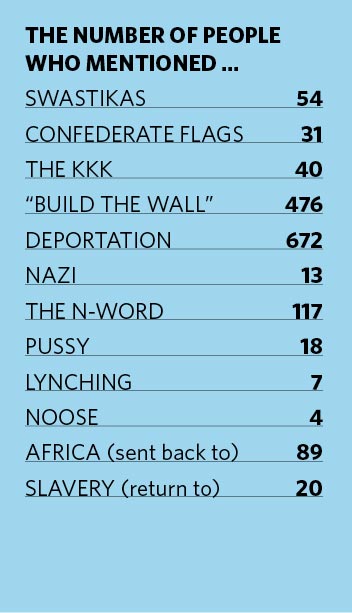
verbal harassment, the use of slurs and derogatory language, and
disturbing incidents involving swastikas, Nazi salutes and Confederate
flags.
Teaching Tolerance conducted a previous survey in March, when we asked teachers how the primary campaign season was affecting our nation’s students. The 2,000 educators who responded reported that the primary season was producing anxiety among vulnerable students and emboldening others to new expressions of politicized bullying. Teachers overwhelming named the source of both the anxiety and the behavior as Donald Trump, then a leading contender for the Republican nomination.
Since Trump was elected, media have been awash in reports of hate incidents around the nation, including at schools. Some detractors have characterized the reports as isolated, exaggerated or even as hoaxes. This survey, which was distributed by several organizations (see About the Survey for a complete list), via email and social media, offers the richest source of information about the immediate impact of the election on our country. The findings show that teachers, principals and district leaders will have an oversized job this year as they work to heal the rifts within school communities.
The survey asked respondents a mix of easily quantifiable questions and also offered them a chance to describe what was happening in open-ended questions. There are over 25,000 responses, in the form of comments and stories, to the open-ended questions. It will take time to fully analyze and report on those comments. This report provides a high-level summary of the findings.
Here are the highlights:
In addition, many teachers who said they were not hearing anti-immigrant or anti-Muslim sentiment or derogatory language pointed out that their students belong exclusively to targeted groups. The dynamics in their schools reflect fear and anxiety about the future (and of the larger community) rather than aggressions between students or groups of students.
The dynamics and incidents these educators reported are nothing short of a crisis and should be treated as such. We end the report with a series of recommendations that school leaders and administrators should take immediately. These include making public statements that set expectations, establishing protocols to identify students who are being targeted or whose emotional needs have changed, doubling down on anti-bullying strategies and being alert to signs of a hostile environment. Most importantly, every school should have a crisis plan to respond to hate and bias incidents.
These are only the initial steps. What new steps will be needed depends entirely on how the rapidly changing political environment (and new federal policies) affect fragile school cultures. At minimum, all schools will need to work to rebuild community; many will need to deal with even more serious threats. The kinds of disruption we describe in this report have long-lasting impacts; school leaders must be ready to respond.
Teaching Tolerance conducted a previous survey in March, when we asked teachers how the primary campaign season was affecting our nation’s students. The 2,000 educators who responded reported that the primary season was producing anxiety among vulnerable students and emboldening others to new expressions of politicized bullying. Teachers overwhelming named the source of both the anxiety and the behavior as Donald Trump, then a leading contender for the Republican nomination.
Since Trump was elected, media have been awash in reports of hate incidents around the nation, including at schools. Some detractors have characterized the reports as isolated, exaggerated or even as hoaxes. This survey, which was distributed by several organizations (see About the Survey for a complete list), via email and social media, offers the richest source of information about the immediate impact of the election on our country. The findings show that teachers, principals and district leaders will have an oversized job this year as they work to heal the rifts within school communities.
The survey asked respondents a mix of easily quantifiable questions and also offered them a chance to describe what was happening in open-ended questions. There are over 25,000 responses, in the form of comments and stories, to the open-ended questions. It will take time to fully analyze and report on those comments. This report provides a high-level summary of the findings.
Here are the highlights:
-
Nine out of 10 educators who responded have seen a negative impact on
students’ mood and behavior following the election; most of them worry
about the continuing impact for the remainder of the school year.
-
Eight in 10 report heightened anxiety on the part of marginalized
students, including immigrants, Muslims, African Americans and LGBT
students.
-
Four in 10 have heard derogatory language directed at students of
color, Muslims, immigrants and people based on gender or sexual
orientation.
-
Half said that students were targeting each other based on which candidate they’d supported.
-
Although two-thirds report that administrators have been
“responsive,” four out of 10 don’t think their schools have action plans
to respond to incidents of hate and bias.
-
Over 2,500 educators described specific incidents of bigotry and
harassment that can be directly traced to election rhetoric. These
incidents include graffiti (including swastikas), assaults on students
and teachers, property damage, fights and threats of violence.
-
Because of the heightened emotion, half are hesitant to discuss the
election in class. Some principals have told teachers to refrain from
discussing or addressing the election in any way.
In addition, many teachers who said they were not hearing anti-immigrant or anti-Muslim sentiment or derogatory language pointed out that their students belong exclusively to targeted groups. The dynamics in their schools reflect fear and anxiety about the future (and of the larger community) rather than aggressions between students or groups of students.
The dynamics and incidents these educators reported are nothing short of a crisis and should be treated as such. We end the report with a series of recommendations that school leaders and administrators should take immediately. These include making public statements that set expectations, establishing protocols to identify students who are being targeted or whose emotional needs have changed, doubling down on anti-bullying strategies and being alert to signs of a hostile environment. Most importantly, every school should have a crisis plan to respond to hate and bias incidents.
These are only the initial steps. What new steps will be needed depends entirely on how the rapidly changing political environment (and new federal policies) affect fragile school cultures. At minimum, all schools will need to work to rebuild community; many will need to deal with even more serious threats. The kinds of disruption we describe in this report have long-lasting impacts; school leaders must be ready to respond.

The election of Donald
Trump is having a major impact on American schools, but how students are
affected — and how educators are addressing the impact — depends
largely on demographics. American schools are increasingly segregated
along racial, ethnic and economic lines. Although individual experiences
will vary, looking at the proportion of students who are African
American, Hispanic and white is a generally dependable indicator of what
each school is experiencing, regardless of whether it is located in a
red or a blue state. We found that how a school reacted ultimately
depended on whether it is a white-majority school, a "minority-majority"
school, or a diverse school with no single group in the majority. This
is a generalization, of course, and there are exceptions, which we
discuss later.
Overall, our public schools serve mainly low-income students of color. But students are not evenly distributed among schools. Here are a few important facts:
The increase in targeting and harassment that began in the spring has, according to the teachers we surveyed, skyrocketed. It was most frequently reported by educators in schools with a majority of white students.
The behavior is directed against immigrants, Muslims, girls, LGBT students, kids with disabilities and anyone who was on the “wrong” side of the election. It ranges from frightening displays of white power to remarks that are passed off as “jokes.”
Here’s a small sampling of the thousands of stories teachers told us that illustrate post-election targeting.
“A group of white students held up a Confederate flag during the pledge of allegiance at a school-wide assembly.” — HIGH SCHOOL COUNSELOR, ARIZONA
“Since the election, every single secondary school in our district has had issues with racist, xenophobic or misogynistic comments cropping up. In the week since the election, I have personally had to deal with the following issues: 1) Boys inappropriately grabbing and touching girls, even after they said no (this never happened until after the election); 2) White students telling their friends who are Hispanic or of color that their parents are going to be deported and that they would be thrown out of school; 3) White students going up to students of color who are total strangers and hurling racial remarks at them, such as, ‘Trump is going [to] throw you back over the wall, you know?’ or ‘We can’t wait until you and the other brownies are gone’; 4) The use of the n-word by white students in my class and in the hallway. Never directed towards a student of color (that I’ve been told yet), but still being casually used in conversation.” — MIDDLE SCHOOL TEACHER, INDIANA
“The slurs have been written on assignments. ‘Send the Muslims back because they are responsible for 9/11.’” — HIGH SCHOOL TEACHER, MINNESOTA
“’I hate Muslims.’ (Student blurted this while the class was learning about major religions.)” — MIDDLE SCHOOL TEACHER, WASHINGTON
“I’ve had a lot of students repeat the phrase ‘Trump that bitch’ in my class, and make jokes about Hispanic students ‘going back to Mexico.’” — HIGH SCHOOL TEACHER, GEORGIA
“A proud proclamation of racism was made by a student after the election: ‘Bet those black people are really scared now.’” — HIGH SCHOOL TEACHER, MICHIGAN
“White males have been overheard saying, ‘screw women’s rights, fag lover liberal, build the wall, lock her up.’ The rebel flag is draped on the truck of a popular student, and the p-word has been used very casually, citing Trump as the excuse.” — HIGH SCHOOL TEACHER, MICHIGAN
“Kids saying, ‘Trump won, you’re going back to Mexico!’ Boys grabbing girls, cornering girls against lockers. Kids yelling, ‘Trump won, so [there will] be less people here soon.’” — HIGH SCHOOL TEACHER, KANSAS
“Today I photographed vandalism in the boy’s bathroom that mentioned a specific black student (1 of 7 in a school of 200). It repeatedly mentioned the KKK, used the n-word and joining Jews. A student drew a swastika on my board a few days ago. A black female ran out of a room crying after being racially harassed by multiple students during two different classes. One student … reported asking two different Latina students if they were ready to move back to Mexico now that Trump is president. I have witnessed an increase in racist and sexist jokes by students who support Trump. I personally spent most of the day putting out fires related to these issues, including documenting and reporting them. Multiple white males also expressed anger over the school wanting to post signs stating we are a sanctuary school.” — HIGH SCHOOL TEACHER, OREGON
“’Kill the n*****s’ etched in school bathroom. Paper with n-word left in my classroom. Neither incident was investigated. Students have told me they no longer need Spanish (the subject I teach) since Trump is sending all the Mexicans back. A black student was blocked from entering his classroom by two white students chanting, ‘Trump, Trump.’” — HIGH SCHOOL TEACHER, TENNESSEE
“Kids did a ‘mock’ election where they got to vote for president and two of 32 kids voted for Trump (this was all before the actual election). One of the students who voted for Trump expressed that he felt kids were judging him for his choice and the teacher defended his position and right to have his own vote. He then said to the class, ‘I just want him to win so he can get rid of all the Mexicans.’ He himself is an immigrant from Bosnia.”— ELEMENTARY TEACHER, COLORADO
“The day after the election I had a group of Hispanic girls in my homeroom targeted by a boy who told them Trump was going to deport their families.” — HIGH SCHOOL TEACHER, NEW JERSEY
“Seventh-grade white boys yelling, ‘Heil Trump!’ Many stories about bigotry have happened outside of school.” — HIGH SCHOOL TEACHER, COLORADO
“Someone anonymously put a swastika with the Trump tag line ‘Make America Great Again’ on the desk of a Spanish teacher.” — HIGH SCHOOL TEACHER, CALIFORNIA
“The day after the election, white students in my school walked down the halls harassing their students of color. One student went around asking, ‘Are you legal?’ to each student he passed. Another student told his black classmate to ‘Go back to Haiti because this is our country now.’” — MIDDLE SCHOOL STUDENT TEACHER, MASSACHUSETTS
“These incidents involve students that I teach in 6th grade: 1) A white student waited outside the boys restroom to target an African-American student, attempting to provoke a fight and calling him ‘n----r.’ The white student had been a vocal Trump supporter; 2) A white male student asked an Asian female student why her eyes looked so funny. The same male student repeatedly asked another male student of Middle Eastern background if he was Muslim and [said] that he ‘hated Muslims.’ Both of these occurred last week following the election.” — MIDDLE SCHOOL TEACHER, VIRGINIA
“In over 15 years of teaching high school this is the first year that swastikas are appearing all over school furniture. The day after the election I overheard a student in the hall chanting, ‘White power.’ I’m appalled! I live in one of the bluest states!” — HIGH SCHOOL TEACHER, WASHINGTON STATE
THE NEW MAJORITY: TRAUMA AND FEAR
Speaking broadly, the survey results indicate that schools with significant numbers of African-American and Hispanic students and immigrant students of color are experiencing what many teachers named as trauma, with all its attendant consequences. A Minnesota high school teacher wrote, “Our school is all immigrant, mostly students in upper teen years (14–21, most are over 16). The levels of anxiety have been through the roof since summer break. It’s very hard for them to think. Their brains can literally handle a fraction of what students could learn in these same classes in the previous 16 years I have taught them. They escaped trauma recently and now are facing it ahead of them (and around them right now).”
These schools with large populations of students of color, many of them also high-poverty schools, report relatively few instances of bigotry in the form of anti-immigrant, anti-Muslim or racist sentiment or language. That’s not, however, a sign that all is well. As several teachers noted, theirs are the students whose identities were disparaged during the election. A California high school teacher reported, “[Our] students have not perpetuated incidents of election-related bigotry or harassment. They perceive themselves to be victims of this throughout their lives, not just because of the election.”
A school social worker in Washington State observed that her school had no incidents of harassment. “On the contrary,” she wrote, “since the vast majority of our students are members of targeted groups, I have seen nothing but a shared sense of fear about what will happen to them and their families.”
The fear comes in many forms: worries about deportation, family separation and general anxiety and hopelessness about the future. Teachers observed that children who are fearful and anxious are unable to concentrate and have a harder time keeping up at school.
The biggest fear of all comes from immigrants; nearly 1,000 teachers specifically named “deportation” or family separation as a concern among students. Given Trump’s promises to deport millions of people here illegally and the uncertainty about what actual policies may ensue, teachers are ill-equipped to address these fears.
Here is a sampling of what fear looks like in schools.
“I teach in a university lab school. The kids come from very diverse cultures, but definitely from middle class, educated families, and STILL they feel threatened. One Muslim girl clung to her kindergarten teacher on November 9 and asked, ‘Are they going to do anything to me? Am I safe?’” — EARLY CHILDHOOD TEACHER, TENNESSEE
“In a 24-hour period, I completed two suicide assessments and two threat of violence assessments for middle school students. This was last week, one week after the election... students were threatening violence against African Americans. Students were suicidal and without hope. Fights, disrespect have increased as well.” — MIDDLE SCHOOL COUNSELOR, FLORIDA
“A kindergartener asked me ‘Why did the bully win?’ Other kids who have been awarded student of the month and considered great examples for our school hid in a classroom after school and drew pokemon fireballs attacking the man. This is a serious issue that we have not clearly addressed. We need help and we must claim our districts and other districts ‘sanctuary districts.’” — ELEMENTARY SCHOOL TEACHER, ARIZONA
“We have over 20 percent Muslim students and 96 percent students of color. Before the election night, in my role in the building as the principal, I was already dealing with children calling Muslims terrorists, boys objectifying girls by calling out obscenities about their private parts, and racial tensions between Latino and Black students. We have had one incident the election night, but our students are really worried about being deported, some Muslim girls are coming to school without their hijabs, and kids have told me they are afraid that a war is going to happen. One child asked me, ‘How are we going to get our freedom back?’” — ELEMENTARY PRINCIPAL, MICHIGAN
“I teach at a charter school in [an inner city]. The student makeup is 99 percent black and Latino children, with the majority qualifying for free or reduced price lunch. The climate in the school itself has been fine, because almost all of the students are people of color. However students have been emotionally distraught, especially the day after the election. Many came to school sobbing, fearing for their future and their families, worried about their relatives being deported. Many expressed sadness that they didn’t realize how messed up the country was until that day, and that they either hated America or now understood why their friends said they hated America.” — MIDDLE SCHOOL TEACHER, NEW JERSEY
“Many of my students feel fear, particularly my students of color, my Latino students, LGBTQ students and so on. They worry about their future and their rights. While we’ve had few episodes of hate, we have had many students (mostly white) tell others to get over it, shake it off and so on. It’s a difficult climate.” — HIGH SCHOOL TEACHER, WASHINGTON STATE
“Most of students come from Hispanic backgrounds. Many of their parents came to the states illegally. We also have some Muslim students. Many of them were crying and so scared the day after Trump won. They are thinking of future plans just in case. My Muslim students wondered why America didn’t like them. It’s been tough and emotionally exhausting.” — MIDDLE SCHOOL TEACHER, PENNSYLVANIA
“Immigrant students reported that the bus on November 9th was full of ‘Terrorist’ or ‘Pack your bags!’ or ‘Go back to where you came from.’ Another student who is Jewish reported, ‘We’ll burn you.’” — HIGH SCHOOL TEACHER, ILLINOIS
“Multi-racial children were telling Hispanic children they were going back to Mexico and their parents were first. Fifth-grade boys were fighting in the bathroom because they found out who voted for Trump in the mock election at school. A lesbian student’s mother was telling her that life as we knew it was over, and she was quite distraught about her mother. Children are very worried about being deported or killed.” — ELEMENTARY COUNSELOR, ILLINOIS
The trauma students are experiencing is putting a strain on school counseling and social work resources and leading teachers to spend more time away from instruction so they can provide emotional support. For some, student distrust of a majority-white teaching force may loom as a new issue. More than one educator commented that her “students believe that white teachers voted for Trump.” It’s impossible to know how long added support will be needed or when trust will be restored.
INCREASED TENSION, LESS COMMUNITY
Finally, in any school that is diverse, especially those with no group in the majority, teachers report that students are tense, have lost trust in each other and are struggling to get along. The divisions opened by the election run deep in these schools.
Here are some stories that show the division, tension and loss of trust.
“We have a mixture of high-income white families and low-income Latino students. The divide has always existed, but with the election over the last year, it’s been WAY worse.” — ELEMENTARY TEACHER, ILLINOIS
“The day after the election, I broke up a fight in the locker room because of differing opinions around each student’s choice for president.” — HIGH SCHOOL TEACHER, ILLINOIS
“’You voted for Trump. I hate you,’ said one third-grader to another.” —ELEMENTARY TEACHER, WASHINGTON
“Half of the students are white with frontier mindset (working in primary industries and a dislike for authority). One-third of the students are Native [American]. One-third of the students are newly arrived first-generation and second-generation immigrants from Central America. The students have grown up together in a small town. The white students wear red ball caps and say terrible things about immigrants, while sitting next to their immigrant friends. The white students are loud about their views. The others are quiet and afraid.” — HIGH SCHOOL TEACHER, OREGON
“I teach in a primarily white, upper middle-class school that largely
supports Trump. Unfortunately, there have been divisions between
students since Trump’s win. My African-American students are refusing to
work with the white students who supported Trump. Students are no
longer looking at each other as people, but are looking at them as who
their parents supported. It is no longer about issues, but about hate
and fear and disagreement and all the things we work our tails off to
teach our students to be careful and wary of. My heart is breaking. And
it was especially broken when the 12-year-old white male student saw an x
on another white male student's paper and said to him, ‘Here, let me
help you,’ and proceeded to draw a swastika on his paper. And our admin
is telling us NOT to talk about it.” — MIDDLE SCHOOL TEACHER, GEORGIA
“There is a lack of trust in the school right now. Many students are unclear as to how to talk to each other.” — HIGH SCHOOL TEACHER, WASHINGTON
“The day after the election a line of students (mainly Hispanic) was formed at lunch. A student (African American) told one of them to ‘Go back to Mexico.’ A fight almost resulted from his comment.” — HIGH SCHOOL TEACHER, NORTH CAROLINA
“We had a race-related fight at a school function in September. My Mexican-American students have been catching comments from kids at school and in the community about being deported, etc. We also had one student post a pro-Trump/anti-black meme that went to 600 other kids’ Instagram feeds. (The words he used are not printable here.)” — HIGH SCHOOL TEACHER, NEW YORK
“We have had many students fighting, especially between the Latino and African-American population, as well as many more boys feeling superior to girls. I have had one male student grab a female student’s crotch and tell her that it’s legal for him to do that to her now. We have not had as many hate crimes in our school as others, but that is likely because we have a VERY small white population. One of my students from last year who is Muslim has not worn her hijab since the election. She is one of three Muslim students in our school.” — ELEMENTARY SCHOOL TEACHER, MINNESOTA
Overall, our public schools serve mainly low-income students of color. But students are not evenly distributed among schools. Here are a few important facts:
-
Total number of public schools: 98,454
-
Percentage of students who are from low-income families: 51
-
Percentage of students who are Hispanic: 25
-
Percentage of students who are African American: 16
-
Percentage of students who are students of color: 50
-
Percentage of schools that are 70% or more minority: 26
-
Percentage of schools that are 70% or more white: 42
-
Percentage of schools with less than 70% of one racial group: 32
The increase in targeting and harassment that began in the spring has, according to the teachers we surveyed, skyrocketed. It was most frequently reported by educators in schools with a majority of white students.
The behavior is directed against immigrants, Muslims, girls, LGBT students, kids with disabilities and anyone who was on the “wrong” side of the election. It ranges from frightening displays of white power to remarks that are passed off as “jokes.”
Here’s a small sampling of the thousands of stories teachers told us that illustrate post-election targeting.
“A group of white students held up a Confederate flag during the pledge of allegiance at a school-wide assembly.” — HIGH SCHOOL COUNSELOR, ARIZONA
“Since the election, every single secondary school in our district has had issues with racist, xenophobic or misogynistic comments cropping up. In the week since the election, I have personally had to deal with the following issues: 1) Boys inappropriately grabbing and touching girls, even after they said no (this never happened until after the election); 2) White students telling their friends who are Hispanic or of color that their parents are going to be deported and that they would be thrown out of school; 3) White students going up to students of color who are total strangers and hurling racial remarks at them, such as, ‘Trump is going [to] throw you back over the wall, you know?’ or ‘We can’t wait until you and the other brownies are gone’; 4) The use of the n-word by white students in my class and in the hallway. Never directed towards a student of color (that I’ve been told yet), but still being casually used in conversation.” — MIDDLE SCHOOL TEACHER, INDIANA
“The slurs have been written on assignments. ‘Send the Muslims back because they are responsible for 9/11.’” — HIGH SCHOOL TEACHER, MINNESOTA
“’I hate Muslims.’ (Student blurted this while the class was learning about major religions.)” — MIDDLE SCHOOL TEACHER, WASHINGTON
“I’ve had a lot of students repeat the phrase ‘Trump that bitch’ in my class, and make jokes about Hispanic students ‘going back to Mexico.’” — HIGH SCHOOL TEACHER, GEORGIA
“A proud proclamation of racism was made by a student after the election: ‘Bet those black people are really scared now.’” — HIGH SCHOOL TEACHER, MICHIGAN
“White males have been overheard saying, ‘screw women’s rights, fag lover liberal, build the wall, lock her up.’ The rebel flag is draped on the truck of a popular student, and the p-word has been used very casually, citing Trump as the excuse.” — HIGH SCHOOL TEACHER, MICHIGAN
“Kids saying, ‘Trump won, you’re going back to Mexico!’ Boys grabbing girls, cornering girls against lockers. Kids yelling, ‘Trump won, so [there will] be less people here soon.’” — HIGH SCHOOL TEACHER, KANSAS
“Today I photographed vandalism in the boy’s bathroom that mentioned a specific black student (1 of 7 in a school of 200). It repeatedly mentioned the KKK, used the n-word and joining Jews. A student drew a swastika on my board a few days ago. A black female ran out of a room crying after being racially harassed by multiple students during two different classes. One student … reported asking two different Latina students if they were ready to move back to Mexico now that Trump is president. I have witnessed an increase in racist and sexist jokes by students who support Trump. I personally spent most of the day putting out fires related to these issues, including documenting and reporting them. Multiple white males also expressed anger over the school wanting to post signs stating we are a sanctuary school.” — HIGH SCHOOL TEACHER, OREGON
“’Kill the n*****s’ etched in school bathroom. Paper with n-word left in my classroom. Neither incident was investigated. Students have told me they no longer need Spanish (the subject I teach) since Trump is sending all the Mexicans back. A black student was blocked from entering his classroom by two white students chanting, ‘Trump, Trump.’” — HIGH SCHOOL TEACHER, TENNESSEE
“Kids did a ‘mock’ election where they got to vote for president and two of 32 kids voted for Trump (this was all before the actual election). One of the students who voted for Trump expressed that he felt kids were judging him for his choice and the teacher defended his position and right to have his own vote. He then said to the class, ‘I just want him to win so he can get rid of all the Mexicans.’ He himself is an immigrant from Bosnia.”— ELEMENTARY TEACHER, COLORADO
“The day after the election I had a group of Hispanic girls in my homeroom targeted by a boy who told them Trump was going to deport their families.” — HIGH SCHOOL TEACHER, NEW JERSEY
“Seventh-grade white boys yelling, ‘Heil Trump!’ Many stories about bigotry have happened outside of school.” — HIGH SCHOOL TEACHER, COLORADO
“Someone anonymously put a swastika with the Trump tag line ‘Make America Great Again’ on the desk of a Spanish teacher.” — HIGH SCHOOL TEACHER, CALIFORNIA
“The day after the election, white students in my school walked down the halls harassing their students of color. One student went around asking, ‘Are you legal?’ to each student he passed. Another student told his black classmate to ‘Go back to Haiti because this is our country now.’” — MIDDLE SCHOOL STUDENT TEACHER, MASSACHUSETTS
“These incidents involve students that I teach in 6th grade: 1) A white student waited outside the boys restroom to target an African-American student, attempting to provoke a fight and calling him ‘n----r.’ The white student had been a vocal Trump supporter; 2) A white male student asked an Asian female student why her eyes looked so funny. The same male student repeatedly asked another male student of Middle Eastern background if he was Muslim and [said] that he ‘hated Muslims.’ Both of these occurred last week following the election.” — MIDDLE SCHOOL TEACHER, VIRGINIA
“In over 15 years of teaching high school this is the first year that swastikas are appearing all over school furniture. The day after the election I overheard a student in the hall chanting, ‘White power.’ I’m appalled! I live in one of the bluest states!” — HIGH SCHOOL TEACHER, WASHINGTON STATE
THE NEW MAJORITY: TRAUMA AND FEAR
Speaking broadly, the survey results indicate that schools with significant numbers of African-American and Hispanic students and immigrant students of color are experiencing what many teachers named as trauma, with all its attendant consequences. A Minnesota high school teacher wrote, “Our school is all immigrant, mostly students in upper teen years (14–21, most are over 16). The levels of anxiety have been through the roof since summer break. It’s very hard for them to think. Their brains can literally handle a fraction of what students could learn in these same classes in the previous 16 years I have taught them. They escaped trauma recently and now are facing it ahead of them (and around them right now).”
These schools with large populations of students of color, many of them also high-poverty schools, report relatively few instances of bigotry in the form of anti-immigrant, anti-Muslim or racist sentiment or language. That’s not, however, a sign that all is well. As several teachers noted, theirs are the students whose identities were disparaged during the election. A California high school teacher reported, “[Our] students have not perpetuated incidents of election-related bigotry or harassment. They perceive themselves to be victims of this throughout their lives, not just because of the election.”
A school social worker in Washington State observed that her school had no incidents of harassment. “On the contrary,” she wrote, “since the vast majority of our students are members of targeted groups, I have seen nothing but a shared sense of fear about what will happen to them and their families.”
The fear comes in many forms: worries about deportation, family separation and general anxiety and hopelessness about the future. Teachers observed that children who are fearful and anxious are unable to concentrate and have a harder time keeping up at school.
The biggest fear of all comes from immigrants; nearly 1,000 teachers specifically named “deportation” or family separation as a concern among students. Given Trump’s promises to deport millions of people here illegally and the uncertainty about what actual policies may ensue, teachers are ill-equipped to address these fears.
Here is a sampling of what fear looks like in schools.
“I teach in a university lab school. The kids come from very diverse cultures, but definitely from middle class, educated families, and STILL they feel threatened. One Muslim girl clung to her kindergarten teacher on November 9 and asked, ‘Are they going to do anything to me? Am I safe?’” — EARLY CHILDHOOD TEACHER, TENNESSEE
“In a 24-hour period, I completed two suicide assessments and two threat of violence assessments for middle school students. This was last week, one week after the election... students were threatening violence against African Americans. Students were suicidal and without hope. Fights, disrespect have increased as well.” — MIDDLE SCHOOL COUNSELOR, FLORIDA
“A kindergartener asked me ‘Why did the bully win?’ Other kids who have been awarded student of the month and considered great examples for our school hid in a classroom after school and drew pokemon fireballs attacking the man. This is a serious issue that we have not clearly addressed. We need help and we must claim our districts and other districts ‘sanctuary districts.’” — ELEMENTARY SCHOOL TEACHER, ARIZONA
“We have over 20 percent Muslim students and 96 percent students of color. Before the election night, in my role in the building as the principal, I was already dealing with children calling Muslims terrorists, boys objectifying girls by calling out obscenities about their private parts, and racial tensions between Latino and Black students. We have had one incident the election night, but our students are really worried about being deported, some Muslim girls are coming to school without their hijabs, and kids have told me they are afraid that a war is going to happen. One child asked me, ‘How are we going to get our freedom back?’” — ELEMENTARY PRINCIPAL, MICHIGAN
“I teach at a charter school in [an inner city]. The student makeup is 99 percent black and Latino children, with the majority qualifying for free or reduced price lunch. The climate in the school itself has been fine, because almost all of the students are people of color. However students have been emotionally distraught, especially the day after the election. Many came to school sobbing, fearing for their future and their families, worried about their relatives being deported. Many expressed sadness that they didn’t realize how messed up the country was until that day, and that they either hated America or now understood why their friends said they hated America.” — MIDDLE SCHOOL TEACHER, NEW JERSEY
“Many of my students feel fear, particularly my students of color, my Latino students, LGBTQ students and so on. They worry about their future and their rights. While we’ve had few episodes of hate, we have had many students (mostly white) tell others to get over it, shake it off and so on. It’s a difficult climate.” — HIGH SCHOOL TEACHER, WASHINGTON STATE
“Most of students come from Hispanic backgrounds. Many of their parents came to the states illegally. We also have some Muslim students. Many of them were crying and so scared the day after Trump won. They are thinking of future plans just in case. My Muslim students wondered why America didn’t like them. It’s been tough and emotionally exhausting.” — MIDDLE SCHOOL TEACHER, PENNSYLVANIA
“Immigrant students reported that the bus on November 9th was full of ‘Terrorist’ or ‘Pack your bags!’ or ‘Go back to where you came from.’ Another student who is Jewish reported, ‘We’ll burn you.’” — HIGH SCHOOL TEACHER, ILLINOIS
“Multi-racial children were telling Hispanic children they were going back to Mexico and their parents were first. Fifth-grade boys were fighting in the bathroom because they found out who voted for Trump in the mock election at school. A lesbian student’s mother was telling her that life as we knew it was over, and she was quite distraught about her mother. Children are very worried about being deported or killed.” — ELEMENTARY COUNSELOR, ILLINOIS
The trauma students are experiencing is putting a strain on school counseling and social work resources and leading teachers to spend more time away from instruction so they can provide emotional support. For some, student distrust of a majority-white teaching force may loom as a new issue. More than one educator commented that her “students believe that white teachers voted for Trump.” It’s impossible to know how long added support will be needed or when trust will be restored.

Finally, in any school that is diverse, especially those with no group in the majority, teachers report that students are tense, have lost trust in each other and are struggling to get along. The divisions opened by the election run deep in these schools.
Here are some stories that show the division, tension and loss of trust.
“We have a mixture of high-income white families and low-income Latino students. The divide has always existed, but with the election over the last year, it’s been WAY worse.” — ELEMENTARY TEACHER, ILLINOIS
“The day after the election, I broke up a fight in the locker room because of differing opinions around each student’s choice for president.” — HIGH SCHOOL TEACHER, ILLINOIS
“’You voted for Trump. I hate you,’ said one third-grader to another.” —ELEMENTARY TEACHER, WASHINGTON
“Half of the students are white with frontier mindset (working in primary industries and a dislike for authority). One-third of the students are Native [American]. One-third of the students are newly arrived first-generation and second-generation immigrants from Central America. The students have grown up together in a small town. The white students wear red ball caps and say terrible things about immigrants, while sitting next to their immigrant friends. The white students are loud about their views. The others are quiet and afraid.” — HIGH SCHOOL TEACHER, OREGON

“There is a lack of trust in the school right now. Many students are unclear as to how to talk to each other.” — HIGH SCHOOL TEACHER, WASHINGTON
“The day after the election a line of students (mainly Hispanic) was formed at lunch. A student (African American) told one of them to ‘Go back to Mexico.’ A fight almost resulted from his comment.” — HIGH SCHOOL TEACHER, NORTH CAROLINA
“We had a race-related fight at a school function in September. My Mexican-American students have been catching comments from kids at school and in the community about being deported, etc. We also had one student post a pro-Trump/anti-black meme that went to 600 other kids’ Instagram feeds. (The words he used are not printable here.)” — HIGH SCHOOL TEACHER, NEW YORK
“We have had many students fighting, especially between the Latino and African-American population, as well as many more boys feeling superior to girls. I have had one male student grab a female student’s crotch and tell her that it’s legal for him to do that to her now. We have not had as many hate crimes in our school as others, but that is likely because we have a VERY small white population. One of my students from last year who is Muslim has not worn her hijab since the election. She is one of three Muslim students in our school.” — ELEMENTARY SCHOOL TEACHER, MINNESOTA
A very small minority
of teachers reported little impact of the election on their schools.
These schools tended to fall into two broad groups.
The first group includes school that are overwhelmingly white, especially in areas with few immigrants or African Americans. These students are isolated, with little exposure to students who are frightened by the election results, and few opportunities to see the world from their perspective. Teachers at these schools report that their students have accepted (or welcomed) the results and have moved on.
Here are some examples of the schools that fall into this category.
“Truly, it hasn’t had a huge impact. Because I talk about these things in class, I have been able to see what little impact there is. Colleagues haven’t seen anything.” — MIDDLE SCHOOL TEACHER, UTAH
“Students stated, regardless of who won, we are still in this country together and we will make the most of it. They really did not see that whoever won would make a difference in their lives.” — HIGH SCHOOL TEACHER, ALABAMA
“If we stop trying to find problems and focus on the future, our country would be a better, more tolerant place to live. I explained to my students how lucky we are to live in the greatest country in the world, a place where we can have a peaceful transition of power; and if you do not agree with the results, we get to do it again in four years.” — HIGH SCHOOL TEACHER, FLORIDA
“I teach current events and the students did a very good job on breaking down how to actually do a true protest that will actually bring change vs. a mass temper tantrum. They also looked into how our democracy works.” — HIGH SCHOOL TEACHER, WASHINGTON STATE
“They reacted, but they moved on faster than the adults are.” — HIGH SCHOOL TEACHER, IDAHO
“I don’t think the election has had a big impact on our school climate. It is a 6–8 middle school in a wealthy suburb. We have mostly white students with a decent size Asian population. It seems that there was support for both sides in our community, but the students seem to be taking the results fairly.” — MIDDLE SCHOOL TEACHER, OHIO
“Absolutely nothing; if anything, this survey is creating more hatred than the election results.” — HIGH SCHOOL TEACHER, RHODE ISLAND
“Our school has a unique demographic and, as a result, the emotions of the election were very mixed. Many of our students are white, middle-to-upper-class and conservative. Many of them were happy with the outcome of the election, much to most teachers’ chagrin. There were, of course, a fair amount of students who were visibly upset as well. A week later, though, and I (sadly) don’t really see much remnants of the election.” — HIGH SCHOOL TEACHER, NEW MEXICO
The second group includes schools that have worked hard at establishing inclusive welcoming communities, have response programs in place, and nurtured qualities of empathy and compassion among students. Many of them report that students are affected, but that they have the language and practices — talking circles, student- led groups, leadership clubs, character programs and proactive staff — that have helped them avoid conflict. “We are keeping a careful, careful watch as teachers and administrators,” noted a North Carolina educator. “We are in solidarity as we seek to see that every child in our school knows his/her value and importance in our community.” A high school teacher in California reported, “The students were devastated by the election results, as were most of our faculty and staff members. However, the darkness of the election brought us all closer together and in a positive and proactive way!”
Other schools are feeling the pressure, though. A Maryland high school teacher said, “We have worked really hard over the last 10 years to change our climate. The last year has nearly undone all of that work. It is disheartening.”
The first group includes school that are overwhelmingly white, especially in areas with few immigrants or African Americans. These students are isolated, with little exposure to students who are frightened by the election results, and few opportunities to see the world from their perspective. Teachers at these schools report that their students have accepted (or welcomed) the results and have moved on.
Here are some examples of the schools that fall into this category.
“Truly, it hasn’t had a huge impact. Because I talk about these things in class, I have been able to see what little impact there is. Colleagues haven’t seen anything.” — MIDDLE SCHOOL TEACHER, UTAH
“Students stated, regardless of who won, we are still in this country together and we will make the most of it. They really did not see that whoever won would make a difference in their lives.” — HIGH SCHOOL TEACHER, ALABAMA
“If we stop trying to find problems and focus on the future, our country would be a better, more tolerant place to live. I explained to my students how lucky we are to live in the greatest country in the world, a place where we can have a peaceful transition of power; and if you do not agree with the results, we get to do it again in four years.” — HIGH SCHOOL TEACHER, FLORIDA
“I teach current events and the students did a very good job on breaking down how to actually do a true protest that will actually bring change vs. a mass temper tantrum. They also looked into how our democracy works.” — HIGH SCHOOL TEACHER, WASHINGTON STATE
“They reacted, but they moved on faster than the adults are.” — HIGH SCHOOL TEACHER, IDAHO
“I don’t think the election has had a big impact on our school climate. It is a 6–8 middle school in a wealthy suburb. We have mostly white students with a decent size Asian population. It seems that there was support for both sides in our community, but the students seem to be taking the results fairly.” — MIDDLE SCHOOL TEACHER, OHIO
“Absolutely nothing; if anything, this survey is creating more hatred than the election results.” — HIGH SCHOOL TEACHER, RHODE ISLAND
“Our school has a unique demographic and, as a result, the emotions of the election were very mixed. Many of our students are white, middle-to-upper-class and conservative. Many of them were happy with the outcome of the election, much to most teachers’ chagrin. There were, of course, a fair amount of students who were visibly upset as well. A week later, though, and I (sadly) don’t really see much remnants of the election.” — HIGH SCHOOL TEACHER, NEW MEXICO
The second group includes schools that have worked hard at establishing inclusive welcoming communities, have response programs in place, and nurtured qualities of empathy and compassion among students. Many of them report that students are affected, but that they have the language and practices — talking circles, student- led groups, leadership clubs, character programs and proactive staff — that have helped them avoid conflict. “We are keeping a careful, careful watch as teachers and administrators,” noted a North Carolina educator. “We are in solidarity as we seek to see that every child in our school knows his/her value and importance in our community.” A high school teacher in California reported, “The students were devastated by the election results, as were most of our faculty and staff members. However, the darkness of the election brought us all closer together and in a positive and proactive way!”
Other schools are feeling the pressure, though. A Maryland high school teacher said, “We have worked really hard over the last 10 years to change our climate. The last year has nearly undone all of that work. It is disheartening.”
Many teachers made a
point of saying that what is happening now is something new. It’s not,
they explained, a different response to an election result, but an
unleashing of a spirit of hatred they had not seen before.
Here are some of their comments.
“I have seen open racism, spoken, for the first time in 23 years of teaching.” — MIDDLE SCHOOL TEACHER, MICHIGAN
“I have never directly encountered race-related harassment in our school until after the election this year.” — MIDDLE SCHOOL TEACHER, WISCONSIN
“There have been more fights in the first 10 weeks of this year than in the first 10 years of my career (this is my 11th year teaching).” — SECONDARY TEACHER, NEW YORK
“Words that I have not heard in the past — racist, bigot, pussy, slut — are now used by my fourth-graders.” — ELEMENTARY TEACHER, MINNESOTA
“This is my 21st year of teaching. This is the first time I’ve had a student call another student the ‘n’ word. This incident occurred the day after a conference with the offender’s mother. During the conference, the mother made her support of Trump known and expressed her hope that ‘the blacks’ would soon ‘know their place again.’” — ELEMENTARY TEACHER, GEORGIA
Clearly, this election is having an effect on students, but teachers are affected as well.
“Teachers are struggling. We are facing division like we’ve never seen before. People are rethinking relationships and opinions of colleagues. Personally, I am wondering if teaching Arthur Miller’s The Crucible might bring me grief. I’ve never even considered such a thought in 20+ years of teaching!” — HIGH SCHOOL TEACHER, IOWA
“An administrator told female and minority teachers that fear was ‘silly’ and ‘ridiculous.’” — MIDDLE SCHOOL TEACHER, CALIFORNIA
“The day after the election, I sat in my car for 30 minutes before school dreading going in to the middle school and seeing the faces of the disappointed students and trying to think of what I was going to say to them. I tried to be encouraging and say they would be safe in the school that no one would be coming to get them in school.” — MIDDLE SCHOOL TEACHER IN A SCHOOL WITH 65 PERCENT STUDENTS OF COLOR, INCLUDING IMMIGRANTS, WISCONSIN
“The day after the election, white male students were seen running through the halls, wearing American flag shorts and socks, Confederate flag shirts and carrying large American flags. The students were told to put their flags away, but they argued that it was freedom of speech. They continued to run through the halls periodically throughout that day. The symbol of our flag was changed for me that day. When I attended a Veteran’s Day service on Thursday, some of those same students were in the ROTC group here. I saw a distinct parallel to Hitler Youth. I am no longer able to recite the Pledge of Allegiance. I am compelled to turn away when it comes on over the loud speaker and am repulsed by ‘liberty and justice for all.’” — HIGH SCHOOL TEACHER, VIRGINIA
Here are some of their comments.
“I have seen open racism, spoken, for the first time in 23 years of teaching.” — MIDDLE SCHOOL TEACHER, MICHIGAN
“I have never directly encountered race-related harassment in our school until after the election this year.” — MIDDLE SCHOOL TEACHER, WISCONSIN
“There have been more fights in the first 10 weeks of this year than in the first 10 years of my career (this is my 11th year teaching).” — SECONDARY TEACHER, NEW YORK
“Words that I have not heard in the past — racist, bigot, pussy, slut — are now used by my fourth-graders.” — ELEMENTARY TEACHER, MINNESOTA
“This is my 21st year of teaching. This is the first time I’ve had a student call another student the ‘n’ word. This incident occurred the day after a conference with the offender’s mother. During the conference, the mother made her support of Trump known and expressed her hope that ‘the blacks’ would soon ‘know their place again.’” — ELEMENTARY TEACHER, GEORGIA
Clearly, this election is having an effect on students, but teachers are affected as well.
“Teachers are struggling. We are facing division like we’ve never seen before. People are rethinking relationships and opinions of colleagues. Personally, I am wondering if teaching Arthur Miller’s The Crucible might bring me grief. I’ve never even considered such a thought in 20+ years of teaching!” — HIGH SCHOOL TEACHER, IOWA
“An administrator told female and minority teachers that fear was ‘silly’ and ‘ridiculous.’” — MIDDLE SCHOOL TEACHER, CALIFORNIA
“The day after the election, I sat in my car for 30 minutes before school dreading going in to the middle school and seeing the faces of the disappointed students and trying to think of what I was going to say to them. I tried to be encouraging and say they would be safe in the school that no one would be coming to get them in school.” — MIDDLE SCHOOL TEACHER IN A SCHOOL WITH 65 PERCENT STUDENTS OF COLOR, INCLUDING IMMIGRANTS, WISCONSIN
“The day after the election, white male students were seen running through the halls, wearing American flag shorts and socks, Confederate flag shirts and carrying large American flags. The students were told to put their flags away, but they argued that it was freedom of speech. They continued to run through the halls periodically throughout that day. The symbol of our flag was changed for me that day. When I attended a Veteran’s Day service on Thursday, some of those same students were in the ROTC group here. I saw a distinct parallel to Hitler Youth. I am no longer able to recite the Pledge of Allegiance. I am compelled to turn away when it comes on over the loud speaker and am repulsed by ‘liberty and justice for all.’” — HIGH SCHOOL TEACHER, VIRGINIA
A few days before the
election, we posted advice to help teachers navigate the day after
Election Day. We knew that, no matter the result, some kids would be
crushed and others would be jubilant. We also knew that, after a
campaign as ugly as this one, teachers would be like medics on the front
lines.
A week later, we saw that school leaders around the country were confronting increasingly volatile school environments. From managing anxiety and fear to responding to derogatory language and acts of bias, principals, superintendents and other district and building leaders have a tremendous challenge ahead.
With this understanding in mind, we offer these suggestions to school administrators.
• SET THE TONE. We’re aware that many superintendents and principals around the country have sent letters to staff and families. If your administration hasn’t, consider doing it now. This one, from Boston’s school superintendent Tommy Chang, is a great model. Your message should affirm your school’s values, set expectations about inclusion and respect, and explain your vision for the school community.
• TAKE CARE OF THE WOUNDED. Many students — especially immigrant, LGBT, Muslim and African-American students — are profoundly upset and worried by the election results. Their anxiety is warranted; many have been targeted in and out of school by individuals who think Trump’s election has licensed hatred and bigotry. Let your school community know that you have a plan — and the necessary resources — to provide for the needs of specific students. Some of them are experiencing trauma. Are your teachers ready?
• DOUBLE DOWN ON ANTI-BULLYING STRATEGIES. Encourage everyone in the school community to be aware of bullying, harassment and bias in all their forms. Remind them of the school’s written policies, and set the expectation that your staff be ready to act. Not everyone has to be a superhero, but everyone can be an ally and an upstander.
• ENCOURAGE COURAGE. It’s especially important to let staff and students know that you expect them to speak up when they see or hear something that denigrates any member of the school community. When students interrupt biased language, calmly ask questions, correct misinformation and echo others who do the same, they send their peers a clear message: This kind of language doesn’t fly here.
• BE READY FOR A CRISIS. The news and social media are awash in posts about ugly bias incidents — and even hate crimes — in our communities and our schools. When an incident happens, you will not have time to learn how to manage it: You need to be prepared. If something happens, we have guidance for managing the crisis and keeping students safe.
Download “Responding to Hate and Bias” now and share it with others.
Teaching Tolerance will further analyze the survey results and continue to use the data to shape our resources and offerings to K–12 teachers and others who work in schools. Visit tolerance.org/voting-elections to view a package of materials currently available to help educators navigate this crisis.
A week later, we saw that school leaders around the country were confronting increasingly volatile school environments. From managing anxiety and fear to responding to derogatory language and acts of bias, principals, superintendents and other district and building leaders have a tremendous challenge ahead.
With this understanding in mind, we offer these suggestions to school administrators.
• SET THE TONE. We’re aware that many superintendents and principals around the country have sent letters to staff and families. If your administration hasn’t, consider doing it now. This one, from Boston’s school superintendent Tommy Chang, is a great model. Your message should affirm your school’s values, set expectations about inclusion and respect, and explain your vision for the school community.
• TAKE CARE OF THE WOUNDED. Many students — especially immigrant, LGBT, Muslim and African-American students — are profoundly upset and worried by the election results. Their anxiety is warranted; many have been targeted in and out of school by individuals who think Trump’s election has licensed hatred and bigotry. Let your school community know that you have a plan — and the necessary resources — to provide for the needs of specific students. Some of them are experiencing trauma. Are your teachers ready?
• DOUBLE DOWN ON ANTI-BULLYING STRATEGIES. Encourage everyone in the school community to be aware of bullying, harassment and bias in all their forms. Remind them of the school’s written policies, and set the expectation that your staff be ready to act. Not everyone has to be a superhero, but everyone can be an ally and an upstander.
• ENCOURAGE COURAGE. It’s especially important to let staff and students know that you expect them to speak up when they see or hear something that denigrates any member of the school community. When students interrupt biased language, calmly ask questions, correct misinformation and echo others who do the same, they send their peers a clear message: This kind of language doesn’t fly here.
• BE READY FOR A CRISIS. The news and social media are awash in posts about ugly bias incidents — and even hate crimes — in our communities and our schools. When an incident happens, you will not have time to learn how to manage it: You need to be prepared. If something happens, we have guidance for managing the crisis and keeping students safe.
Download “Responding to Hate and Bias” now and share it with others.
Teaching Tolerance will further analyze the survey results and continue to use the data to shape our resources and offerings to K–12 teachers and others who work in schools. Visit tolerance.org/voting-elections to view a package of materials currently available to help educators navigate this crisis.
The discussion in this
report summarizes responses to questions posed by Teaching Tolerance via
an informal online survey launched on November 14, 2016; the data
reported here is based on the responses as of November 23. A link to the
survey was sent to educators who subscribe to the Teaching Tolerance
newsletter and was also shared on Teaching Tolerance’s social media
sites. It was open to any educator who wanted to participate. Several
other groups, including Facing History and Ourselves, Teaching for
Change, Not in Our Schools, the American
Federation of Teachers and Rethinking Schools, also shared the survey link with their audiences.
The survey questions can be found here and are included as an appendix to this report.
In the course of just over a week, over 10,000 people responded to the survey. Collectively, they submitted over 25,000 comments. Nearly all respondents identified themselves by name, email address, grade level and state. More than 1,500 signified a willingness to go on record by giving permission for Teaching Tolerance to share their contact information with the media.
The results of this survey are not scientific. The respondents were not selected in a manner to ensure a representative sample; those who responded may have been more likely to perceive problems than those who did not. But it is the largest collection of educator responses that has been collected; the tremendous number of responses as well as the overwhelming confirmation of what has been anecdotally reported in the media cannot be ignored or dismissed.
SURVEY QUESTIONS
1. How would you describe the impact of the election results on your school’s climate?
• VERY NEGATIVE • SOMEWHAT NEGATIVE • SOMEWHAT POSITIVE • VERY POSITIVE
2. How concerned are you about your school climate for the remainder * of the year?
• NOT AT ALL CONCERNED • SOMEWHAT CONCERNED • VERY CONCERNED • EXTREMELY CONCERNED
3. Is there anything you’d like to tell us about your school and the students you serve?
4. How has the election affected the mood and behavior of students at your school?
Since the election:
My students have expressed concern about what might happen to them or their families.
• Strongly disagree • Somewhat disagree • Somewhat agree • Strongly agree
There has been anti-immigrant sentiment at my school.
• Strongly disagree • Somewhat disagree • Somewhat agree • Strongly agree
There has been anti-Muslim sentiment at my school.
• Strongly disagree • Somewhat disagree • Somewhat agree • Strongly agree
I have heard derogatory language or slurs about students of color.
• Strongly disagree • Somewhat disagree • Somewhat agree • Strongly agree
I have heard derogatory language or slurs about white students.
• Strongly disagree • Somewhat disagree • Somewhat agree • Strongly agree
I have heard derogatory language or slurs based on gender or sexual orientation.
• Strongly disagree • Somewhat disagree • Somewhat agree • Strongly agree
Students are targeting other students based on who they supported in the election.
• Strongly disagree • Somewhat disagree • Somewhat agree • Strongly agree
5. If specific incidents of election-related bigotry or harassment have occurred in your school, please describe them. You may include a link.
6. Please describe any examples of hope or inclusion that have occurred in your school following the election.
7. How are you, other educators and administration responding?
• My administration is being responsive to the post-election climate.
• My school has an action plan for when incidents of hate or bias occur.
• I am hesitant to teach about the election results and post-election season.
• Teachers or administrators are being harassed for standing up for children.
Please provide details about any of the above statements.
8. Use this space for comments or additional information you'd like to share.
9. What resources or support do you and your school need?
10. What resources, programs or interventions are you currently using?
Please let us know about yourself. We need your name and will not share it without your permission. This is necessary so we can verify the data. Reports of harassment at school are being dismissed as "hoaxes," and we know that some social media anecdotes have been found to be pranks. We need solid data from educators.
We're depending on you.
11. At what school level do you work?
• Early childhood to pre-K
• Elementary education K-5
• Middle school 6-8
• High school 9-12
• Higher ed
• Other (please specify)
12. What is your main job role?
• Teacher
• Counselor
• Building administrator
• District administrator
• Librarian
• Professor
• Other (please specify)
13. What is your name? (We will not share it without your permission.)
14. Please provide your email address. (We will never share your email address without your permission.)
15. In what state or U.S. territory do you work?
16. What city?
17. The report we wrote after our last survey drew the media's attention to classrooms. We expect this to happen again. If you would like the opportunity to tell your story or the story of your students, answer YES. It gives us permission to give your email address to a journalist.
• YES, you may share my email address.
Thank you for taking the time to respond to our survey.
Federation of Teachers and Rethinking Schools, also shared the survey link with their audiences.
The survey questions can be found here and are included as an appendix to this report.
In the course of just over a week, over 10,000 people responded to the survey. Collectively, they submitted over 25,000 comments. Nearly all respondents identified themselves by name, email address, grade level and state. More than 1,500 signified a willingness to go on record by giving permission for Teaching Tolerance to share their contact information with the media.
The results of this survey are not scientific. The respondents were not selected in a manner to ensure a representative sample; those who responded may have been more likely to perceive problems than those who did not. But it is the largest collection of educator responses that has been collected; the tremendous number of responses as well as the overwhelming confirmation of what has been anecdotally reported in the media cannot be ignored or dismissed.

SURVEY QUESTIONS
1. How would you describe the impact of the election results on your school’s climate?
• VERY NEGATIVE • SOMEWHAT NEGATIVE • SOMEWHAT POSITIVE • VERY POSITIVE
2. How concerned are you about your school climate for the remainder * of the year?
• NOT AT ALL CONCERNED • SOMEWHAT CONCERNED • VERY CONCERNED • EXTREMELY CONCERNED
3. Is there anything you’d like to tell us about your school and the students you serve?
4. How has the election affected the mood and behavior of students at your school?
Since the election:
My students have expressed concern about what might happen to them or their families.
• Strongly disagree • Somewhat disagree • Somewhat agree • Strongly agree
There has been anti-immigrant sentiment at my school.
• Strongly disagree • Somewhat disagree • Somewhat agree • Strongly agree
There has been anti-Muslim sentiment at my school.
• Strongly disagree • Somewhat disagree • Somewhat agree • Strongly agree
I have heard derogatory language or slurs about students of color.
• Strongly disagree • Somewhat disagree • Somewhat agree • Strongly agree
I have heard derogatory language or slurs about white students.
• Strongly disagree • Somewhat disagree • Somewhat agree • Strongly agree
I have heard derogatory language or slurs based on gender or sexual orientation.
• Strongly disagree • Somewhat disagree • Somewhat agree • Strongly agree
Students are targeting other students based on who they supported in the election.
• Strongly disagree • Somewhat disagree • Somewhat agree • Strongly agree
5. If specific incidents of election-related bigotry or harassment have occurred in your school, please describe them. You may include a link.
6. Please describe any examples of hope or inclusion that have occurred in your school following the election.
7. How are you, other educators and administration responding?
• My administration is being responsive to the post-election climate.
• My school has an action plan for when incidents of hate or bias occur.
• I am hesitant to teach about the election results and post-election season.
• Teachers or administrators are being harassed for standing up for children.
Please provide details about any of the above statements.
8. Use this space for comments or additional information you'd like to share.
9. What resources or support do you and your school need?
10. What resources, programs or interventions are you currently using?
Please let us know about yourself. We need your name and will not share it without your permission. This is necessary so we can verify the data. Reports of harassment at school are being dismissed as "hoaxes," and we know that some social media anecdotes have been found to be pranks. We need solid data from educators.
We're depending on you.
11. At what school level do you work?
• Early childhood to pre-K
• Elementary education K-5
• Middle school 6-8
• High school 9-12
• Higher ed
• Other (please specify)
12. What is your main job role?
• Teacher
• Counselor
• Building administrator
• District administrator
• Librarian
• Professor
• Other (please specify)
13. What is your name? (We will not share it without your permission.)
14. Please provide your email address. (We will never share your email address without your permission.)
15. In what state or U.S. territory do you work?
16. What city?
17. The report we wrote after our last survey drew the media's attention to classrooms. We expect this to happen again. If you would like the opportunity to tell your story or the story of your students, answer YES. It gives us permission to give your email address to a journalist.
• YES, you may share my email address.
Thank you for taking the time to respond to our survey.
1. U.S. Department of
Education, National Center for Education Statistics, Fast Facts:
Education Institutions, accessed November 27, 2016, https://nces.ed.gov/fastfacts/display.asp?id=84
2. Southern Education Foundation, A New Majority Research Bulletin: Low Income Students Now a Majority in the Nation's Public Schools, accessed November 27, 2016, http://www.southerneducation.org/ Our-Strategies/Research-and-Publications/New-Majority-Diverse-Majority-Report-Series/A-NewMajority-2015-Update-Low-Income-Students-Now
3. U.S. Department of Education, National Center for Education Statistics, Common Core Data: State Nonfiscal Survey of Public Elementary and Secondary Education, accessed November 27, 2016, https://nces.ed.gov/ ccd/stnfis.asp U.S. Department of Education, National Center for Education Statistics, The Condition of Education: Racial/Ethnic Enrollment in Public Schools, accessed November 27, 2016, http://nces.ed.gov/programs/coe/ indicator_cge.asp
4. Ibid.
5. Leslie A. Maxwell, “U.S. school enrollment hits majority-minority milestone,” Education Week, August 19, 2014, accessed November 27, 2016, http://www.edweek.org/ew/articles/2014/08/20/01demographics.h34. html
6. Market Data Research school data, accessed via subscription November 27, 2016.
7. Ibid.
8. Ibid
2. Southern Education Foundation, A New Majority Research Bulletin: Low Income Students Now a Majority in the Nation's Public Schools, accessed November 27, 2016, http://www.southerneducation.org/ Our-Strategies/Research-and-Publications/New-Majority-Diverse-Majority-Report-Series/A-NewMajority-2015-Update-Low-Income-Students-Now
3. U.S. Department of Education, National Center for Education Statistics, Common Core Data: State Nonfiscal Survey of Public Elementary and Secondary Education, accessed November 27, 2016, https://nces.ed.gov/ ccd/stnfis.asp U.S. Department of Education, National Center for Education Statistics, The Condition of Education: Racial/Ethnic Enrollment in Public Schools, accessed November 27, 2016, http://nces.ed.gov/programs/coe/ indicator_cge.asp
4. Ibid.
5. Leslie A. Maxwell, “U.S. school enrollment hits majority-minority milestone,” Education Week, August 19, 2014, accessed November 27, 2016, http://www.edweek.org/ew/articles/2014/08/20/01demographics.h34. html
6. Market Data Research school data, accessed via subscription November 27, 2016.
7. Ibid.
8. Ibid
This report was written
by Maureen B. Costello and edited by Richard Cohen and Adrienne van der
Valk. Russell Estes designed the layout.
SOUTHERN POVERTY LAW CENTER
CO-FOUNDERS Morris Dees, Joseph J. Levin Jr.
PRESIDENT & CEO J. Richard Cohen
INTELLIGENCE PROJECT DIRECTOR Heidi Beirich
OUTREACH DIRECTOR Lecia Brooks
LEGAL DIRECTOR Rhonda Brownstein
CHIEF COMMUNICATIONS & DEVELOPMENT OFFICER Wendy Via
TEACHING TOLERANCE
DIRECTOR Maureen B. Costello
DEPUTY DIRECTOR Adrienne van der Valk
MANAGER, TEACHING AND LEARNING Hoyt J. Phillips III
TEACHING AND LEARNING SPECIALISTS Jarah Botello, Lauryn Mascareñaz
SENIOR EDITOR Monita K. Bell
WRITER/ASSOCIATE EDITOR Maya Lindberg
RESEARCH ASSOCIATE Margaret Sasser
TECHNICAL LEAD D. Scott McDaniel
NEW MEDIA SPECIALIST Tiffany Gibert
PROGRAM COORDINATOR Steffany Moyer
ADMINISTRATIVE ASSISTANT Cecile Jones
INTERN Alexis Ofe
DESIGN
DESIGN DIRECTOR Russell Estes
SENIOR DESIGNER Valerie Downes
DESIGNERS Michelle Leland, Sunny Paulk, Scott Phillips, Kristina Turner
DESIGN ASSOCIATE Shannon Anderson
SOUTHERN POVERTY LAW CENTER
CO-FOUNDERS Morris Dees, Joseph J. Levin Jr.
PRESIDENT & CEO J. Richard Cohen
INTELLIGENCE PROJECT DIRECTOR Heidi Beirich
OUTREACH DIRECTOR Lecia Brooks
LEGAL DIRECTOR Rhonda Brownstein
CHIEF COMMUNICATIONS & DEVELOPMENT OFFICER Wendy Via
TEACHING TOLERANCE
DIRECTOR Maureen B. Costello
DEPUTY DIRECTOR Adrienne van der Valk
MANAGER, TEACHING AND LEARNING Hoyt J. Phillips III
TEACHING AND LEARNING SPECIALISTS Jarah Botello, Lauryn Mascareñaz
SENIOR EDITOR Monita K. Bell
WRITER/ASSOCIATE EDITOR Maya Lindberg
RESEARCH ASSOCIATE Margaret Sasser
TECHNICAL LEAD D. Scott McDaniel
NEW MEDIA SPECIALIST Tiffany Gibert
PROGRAM COORDINATOR Steffany Moyer
ADMINISTRATIVE ASSISTANT Cecile Jones
INTERN Alexis Ofe
DESIGN
DESIGN DIRECTOR Russell Estes
SENIOR DESIGNER Valerie Downes
DESIGNERS Michelle Leland, Sunny Paulk, Scott Phillips, Kristina Turner
DESIGN ASSOCIATE Shannon Anderson
Subscribe to:
Posts (Atom)