Saturday, July 28, 2012

Stop the 'Special Education Placement' bill!!

The Racist Power of Ten: 
 East Ramapo, NY School Board Bumrush

Veto S7722!!
The NY State Senate sent the 'Special Education Placement' bill to the Governor on Friday. He could sign it any day now, so there is no time to waste. Please reach out to all your contacts right now! E-mail, Facebook, Twitter, or any other way you know. Let's stop this unfunded mandate that will promote segregation in special education!
http://www.change.org/petitions/governor-andrew-m-cuomo-veto-s7722-the-special-education-placement-bill

Friday, July 27, 2012

Racist Roots of Charter Schools

Why the Racist History of the Charter School Movement Is Never Discussed 

Touted as the cure for what ails public education, charter schools have historical roots that are rarely discussed.

Photo Credit: Shutterstock.com
As a parent I find it easy to understand the appeal of charter schools, especially for parents and students who feel that traditional public schools have failed them. As a historical sociologist who studies race and politics, however, I am disturbed both by the significant challenges that plague the contemporary charter school movement, and by the ugly history of segregationist tactics that link past educational practices to the troubling present.

The now-popular idea of offering public education dollars to private entrepreneurs has historical roots in white resistance to school desegregation after Brown v. Board of Education (1954). The desired outcome was few or, better yet, no black students in white schools. In Prince Edward County, Virginia, one of the five cases decided in Brown, segregationist whites sought to outwit integration by directing taxpayer funds to segregated private schools.

Two years before a federal court set a final desegregation deadline for fall 1959, local newspaper publisher J. Barrye Wall shared white county leaders’ strategy of resistance with Congressman Watkins Abbitt: “We are working [on] a scheme in which we will abandon public schools, sell the buildings to our corporation, reopen as privately operated schools with tuition grants from [Virginia] and P.E. county as the basic financial program,” he wrote. “Those wishing to go to integrated schools can take their tuition grants and operate their own schools. To hell with 'em.”

Though the county ultimately refused to sell the public school buildings, public education in Prince Edward County was nevertheless abandoned for five years (1959-1964), as taxpayer dollars were funneled to the segregated white academies, which were housed in privately owned facilities such as churches and the local Moose Lodge. Federal courts struck down this use of taxpayer funds after a year. Still, whites won and blacks lost. Because there were no local taxes assessed to operate public schools during those years, whites could invest in private schools for their children, while blacks in the county—unable and unwilling to finance their own private, segregated schools—were left to fend for themselves, with many black children shut out of school for multiple years.

Meanwhile, in less blatant attempts to avoid desegregation, states and localities also enacted “freedom of choice” plans that typically allowed white students to transfer out of desegregated schools, but forced black students to clear numerous administrative hurdles and, not infrequently, withstand harassment from teachers and students if they entered formerly all-white schools. When some segregationists began to acknowledge that separate black and white schools were no longer viable legally, they sought other means to eliminate "undesirables."

Attorney David Mays, who advised high-ranking Virginia politicians on school strategy, reasoned, “Negroes could be let in [to white schools] and then chased out by setting high academic standards they could not maintain, by hazing if necessary, by economic pressures in some cases, etc. This should leave few Negroes in the white schools. The federal courts can easily force Negroes into our white schools, but they can’t possibly administer them and listen to the merits of thousands of bellyaches.” (Mays vastly underestimated the determination of individual black families and federal officials.)

These nefarious motives may seem a far cry from the desire of many charter school operators to “reinvent” public education for students whom traditional public schools have failed. In theory, these committed bands of reformers come with good intentions: they purport to bring in dedicated teachers who have not been pummeled into complacency; energize their students by creating by a caring, rigorous school environment; and build a parent body that is inspired (in some cases compelled) to become more involved in their children’s education both inside and outside the school. And in some cases, charter schools deliver what they promise. In others, however, this sparkling veneer masks less attractive realities that are too often dismissed, or ignored, as the complaints of reactionaries with a vested interest in propping up our failed system of public education.

The driving assumption for the pro-charter side, of course, is that market competition in education will be like that for toothpaste — providing an array of appealing options. But education, like healthcare, is not a typical consumer market. Providers in these fields have a disincentive to accept or retain “clients” who require intensive interventions to maintain desired outcomes—in the case of education, high standardized test scores that will allow charters to stay in business. The result? A segmented marketplace in which providers compete for the “good risks,” while the undesirables get triage. By design, markets produce winners, losers and unintended or hidden consequences.

Charter school operators (like health insurers who exclude potentially costly applicants) have developed methods to screen out applicants who are likely to depress overall test scores. Sifting mechanisms may include interviews with parents (since parents of low-performing students are less likely to show up for the interview), essays by students, letters of recommendation and scrutiny of attendance records. Low-achieving students enrolled in charters can, for example, be recommended for special education programs that the school lacks, thus forcing their transfer to a traditional public school. (More brazenly, some schools have experienced, and perhaps even encouraged, rampant cheating on standardized tests.)

Operators have clear motives to avoid students who require special services (i.e., English-language learners, “special needs” children and so on) and those who are unlikely to produce the high achievement test scores that form the basis of school evaluations. Whether intended or otherwise, these sifting mechanisms have the ultimate effect of reinscribing racial and economic segregation among the students they educate -- as the research on this topic is increasingly bearing out.

A 2010 report by the UCLA-based Civil Rights Project, "Choice without Equity: Charter School Segregation and the Need for Civil Rights Standards," uncovers some troublesome facts in this regard. “While segregation for blacks among all public schools has been increasing for nearly two decades, black students in charter schools are far more likely than their traditional public school counterparts to be educated in intensely segregated settings. At the national level, 70 percent of black charter school students attend intensely segregated minority charter schools (which enroll 90-100 percent of students from under-represented minority backgrounds), or twice as many as the share of intensely segregated black students in traditional public schools.”

In the first decade of the 2000s, charter school enrollment nearly tripled; today around 2.5 percent of public school students are enrolled in charters. Blacks are overrepresented in charter schools (32 percent vs. 16 percent in the entire public-school population), whites are underrepresented (39 percent versus 56 percent), and Latinos, Asians and American Indians are enrolled in roughly equal proportions in charters and traditional public schools. These snapshots mask considerable variation. In the West and some areas of the South, it appears that charter schools “serve as havens for white flight from public schools,” according to the Civil Rights Project.

There are also preliminary indications that some charter schools under-enroll students qualifying for free lunch and English-language learners, thereby reducing the enrollment of low-income and Latino students, but data is limited in these areas, as it is on non-test-related factors such as graduation rates and college enrollment. How can we compare the performance of charters versus traditional public schools if we don’t know whether they are enrolling the same types of students? At the national and state levels, policymakers are pushing for the rapid expansion of charter schools on the basis of hope rather than evidence.

This points to a larger historical issue. The widespread enthusiasm for and rapid proliferation of charter schools also appears to mirror a persistent issue in American education: expanding new programs before we know if they work, and how successes might be replicated on a larger scale.

As the historian Charles M. Payne observed, “Perhaps the safest generalization one can make about urban schools or school districts is that most of them are trying to do too much too fast, initiating programs on the basis of what’s needed rather than on the basis of what they are capable of.” As charter schools face the uncertainty of contract renewal (which occurs typically at the three- to five-year mark), they may be tempted to overlay a multitude of seemingly innovative instructional strategies without sufficient monitoring of effectiveness.

Some schools do adopt approaches that seem to help students make demonstrable gains in achievement tests. (There are ongoing debates about the extent to which increases in test scores reflect authentic hikes in skills and knowledge, as opposed to a mastery of test-taking techniques.) But even when we identify charter schools that appear to improve performance in relation to students with similar characteristics in the public schools, the question becomes one of scaling up. The concept of charter schools is that they will all be distinctive, with different mixes of students, teaching philosophies, school environments and so on. In theory, other schools—traditional public and other charters—will learn what works, and replicate these innovations.

This has proven terribly difficult to do with successful public schools; doing so with a small, idiosyncratic charter school geared toward students who love the cello poses even greater hurdles.  When researchers from the RAND Corporation studied charter schools in Philadelphia, they noted that “with so many interventions under way simultaneously…there is no way to determine exactly which components of the reform plan are responsible for [any] improvement”—though ultimately they found that privately operated schools produced no more successful outcomes than their traditional public counterparts.

As important as applying successful techniques to other schools is an issue at the other end of the spectrum: when to conclude that a charter has failed. Policymakers such as New York Mayor Michael Bloomberg who have sold charters as the route to educational salvation may be reluctant to pull the plug on failures. The Big Apple has closed roughly 4 percent of charters since its first one opened in 1999, well below the national closing rate of 15 percent. The appropriate rate of charter revocation is anyone’s guess.

By all appearances, charters will remain on the educational landscape for the foreseeable future. While charter skeptics can’t merely wish them away, they can push for greater accountability—after all, isn’t this the whole point of charters? Anyone who blindly accepts that competition will improve education for students in charters and traditional public schools alike should remember that other articles of faith about the market—like cutting taxes on the rich will make all of our yachts and rafts rise—have proven illusory.

The market is not a self-regulating mechanism: players need rules to guide their behavior. Educational history offers some valuable lessons to keep in mind. First, when public schools have great influence in selecting their student body, this can either lead to greater diversity and opportunity while retaining choice (as in some magnet schools), or it can exacerbate persistent problems of racial and economic segregation. Businesspeople respond to incentives, and the impetus for charter-school operators is to “skim the cream” and avoid undesirables. Tangible rewards for charter schools to offer free transportation and lunches, and to craft racially and economically diverse student bodies, could be a step in the right direction.

Educational history also teaches us to be wary of the deep and authentic desire to find the “secret sauce” that produces hard-working, high-achieving students and committed teachers.  It is not easy to identify the factors that make a school great, and it is even harder to disseminate these reforms widely. If, for example, we discover that Charter School X produces exemplary outcomes because of exceptionally talented, committed teachers and unusually industrious students, how do we go about replicating that -- and at what cost? Are all teachers and students capable of reaching these heights, or is there a limited pool? It would be nice to think the former, but evidence for such optimism is scarce.

There is no magic elixir that will fix our educational system. Of course, we should continue to be open to fresh ideas about improving school organization, teaching and learning. But if we continue to ignore important historical lessons about the dangerous consequences of educational privatization and fail to harness our desire to plunge headlong into unproven reform initiatives, we may discover that the cure we so lovingly embraced has made the patient sicker.
Christopher Bonastia is associate professor of sociology at Lehman College and the CUNY Graduate Center. He is the author of "Southern Stalemate: Five Years without Public Education in Prince Edward County, Virginia" (University of Chicago Press, 2012).

Sunday, July 22, 2012

This Is What's Wrong With America: Ignorance By Capitalist Design

Monday, June 4, 2012

Critique of the Charter School Invasion- Frontline for the Privateers


Jun 3, 2012 by

Danny Weil, a charter education expert, journalist, former public policy lawyer and activist discusses Governor Brown's so called "compromise" tax initiative and what it will really mean for public education. He calls it a subsidy for charters that will help further privatization of all public education in California. He also discusses the role of the NEA, AFT, and CFT in "lacing" themselves with money from privatizers such as the Bill an Melinda Gates Foundation and other "non-profit" foundations. 

Weil is also author of "Vouchers and Privatization of Education" and "Charter School Movement" 

The presentation was made in Berkeley, California on June 2, 2012
Production of United Public Workers For Action www.upwa.info
----------------------------

Public Education, Privatization, Corruption And The Destruction Of Our Schools


At a California conference titled "Keep the Community in Community College"
on May 12th, a panel at San Francisco Community College Mission campus
was presented by United Public Workers For Action UPWA.info about privatization and the attack on public education. The title was Public Education, Privatization, Corruption And The Destruction Of Our Schools.

Madeline Mueller, AFT 2121, Professor San Francisco City College Music Department George Wright, Professor, AFT 1493 Skyline College San Mateo College District Kathy Carroll, lawyer and whistleblower at the California Commission On Teacher. Attorney Kathleen Carroll reported that the Governor Brown tax initiative "compromise" supported by the California Teachers Association and California Federation of Teachers along with the California AFL-CIO would permanently deregulate the oversight of the charter schools in California and allow further corruption, nepotism and conflicts of interests.

The conference had other panels and discussed the formation of a student union in California.

United Public Workers For Action www.upwa.info

Monday, May 21, 2012

Not Waiting for Superman--
The Inconvenient Truth About Waiting for Superman
The People's Answer to the Privateers' Antiteacher/AntiParent Union Busting Slick Documentary

Contact:
Lisa Donlan, Parent and President CEC1:  917-848-5873
Julie Cavanagh, Teacher PS 15, GEM/CAPE: 917-836-6465
Brian Jones, Teacher PS 30, GEM: 646-554-8592 
One year ago, The Grassroots Education Movement premiered a new documentary, written and directed by New York City public school teachers and parents, created in response to Davis Guggenheim’s highly misleading film. Waiting for "Superman" would have audiences believe that free-market competition, standardized tests, destroying teacher unions, and the proliferation of charter schools are just what this country needs to create great public schools.
The Inconvenient Truth Behind Waiting For "Superman" highlights the real-life experiences of public school parents, students and educators to show how these so-called reforms are actually hurting public education. The film discusses the kinds of real reform – inside schools and in our society as a whole  – that we urgently need to genuinely transform education in this country.

Saturday, May 12, 2012

Educating for Democracy: 

The People's Board of Education 

Joel Shatsky- Huffington Post

Seku Braithwaite starting the afternoon working groups session

Posted: 05/10/2012 

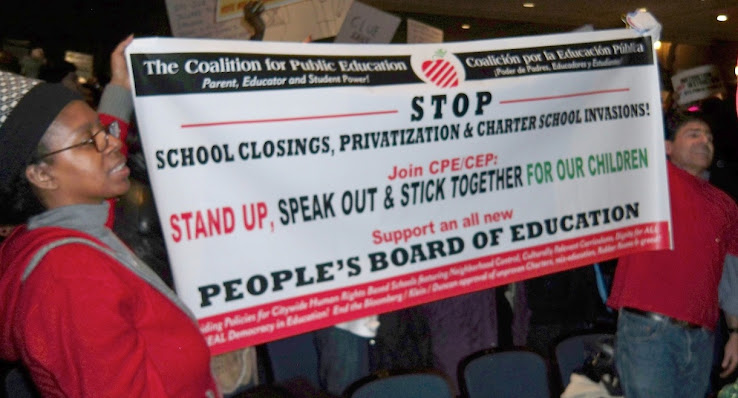
At an all-day meeting featuring panel discussions and break-out sessions, a group of parents, students, teachers and other educators met to propose an alternative to Mayoral control of the New York City public school system. Sponsored by the CPE (Coalition for Public Education) an education advocacy group, and held at the District 37 (AFSCME) building, the conference centered on strategies to establish a People's Board of Education as a way of giving parents of young learners in the public school system a decision-making voice in their children's education.

At the conference which featured a number of educational "true reform" activists such as Jitu Weusi, Benita Rivera, Sam Anderson, David Dubosz, and Brian Jones among many participants, several of them recalled the time in which community control of the schools was implemented in the 1960s and the controversies surrounding the Ocean Hill-Brownsville district in Brooklyn.
 Folk working hard in the People's Board of Education founding meeting.

Ms. Rivera recounted the disappointment she and her son had when he became enrolled in the Henry Street School of International Studies, with its promises of foreign travel for the students. She pointed out that most of these promises were unfulfilled, that only a tiny fraction of the students who entered the program as freshmen actually graduated and that the staffing included mostly inexperienced teachers, some without certification.

Sam Anderson emphasized the "corporate connection" between the public schools and corporate influence during the Bloomberg Administration's control of the schools. He underlined the importance of public education as a "human right" and that the way in which the schools were presently run, much of it for the benefit of corporations, was a violation of that right. As an alternative to Mayoral control, he proposed a People's Board of Education to be made up of "parents, grandparents, students, community members and educators who will be charged to serve only the interests of parents, students and their communities."

Among its guiding principles would be the right of parents, students and the community to:
  1. Participate in the governance of the educational system;
  2. Independently monitor the system;
  3. Receive adequate training and information that would ensure effective participation in the system;
  4. Employ effective and timely remedies when rights are being violated.
Other proposals involving the PBE would be community participation in developing a "new vision of free anti-racist public education in NYC," a way to "participate and monitor the results of future reorganization efforts," and thus "assure that federal, state and city laws provide independent public oversight of the public education system."
 Another Working Group Charting out Strategies & Tactics to help empower the NYC People's Board of Education.

The major emphasis of the PBE would enable community members of the neighborhoods in which the public schools are located who are knowledgeable in pedagogy, education law, community organizing, and training, and fundraising and media connections to participate in forming and directing its policies. Not, as is presently the case, being shut out of any input into the decision-making process of the PEP (Panel on Educational Policy), which is a rubber stamp for the Bloomberg Administration.

Brian Jones, a noted educator and producer of the documentary The Inconvenient Truth Behind 'Waiting for Superman,' a critical response to the hyped documentary about charter schools, Waiting for Superman, pointed out that the consequences of the Ocean Hill-Brownsville controversy divided teachers from parents and that now "connecting the dots" means that parents and teachers need to unite in the common cause.

The effects of the Bloomberg administration's handling of the schools can also be seen, according to another participant, in a significant decline in the number of African-American and Latino teachers recruited into the system since Mayoral control was implemented. The importance of having positive role models in a predominantly minority student population cannot be underestimated.

Other issues such as the negative influence on communities when "charter schools" are co-located in neighborhood schools, the more inclusive, multi-cultural teaching materials that were an integral part of the school curriculum in the 1960s, and the need for getting the police out of the schools were among the many other topics aired. The afternoon of the conference consisted of planning for future meetings and outreach strategies for the wider community.

Assemblywoman Inez Barron is presenting a bill to the New York State Assembly to establish a People's Board of Education as an alternative to Mayoral control. Given the recent critical report by the Schott Foundation that the present policies of the Bloomberg administration have contributed to "educational redlining" and its resultant failures to improve the public schools if not make them worse than when he took control, the alternative of a People's Board of Education seems worth serious consideration.

The People's Board Of Education will meet again on Saturday June 2 to continue to expand its base in all of New York City's neighborhoods.
 Some of the youth helping to form the People's Board of Education that will have Youth engaged in decision-making at every level of school governance.

Tuesday, May 8, 2012

Quick! Cut the Bloomberg Privatization Branches!
Loretta Prisco- Staten Island Education Activist
Insanity: doing the same thing over and over again and expecting different results… or anyone who doesn't take truth seriously in small matters cannot be trusted in large ones either. 
(Albert Einstein)

Several weeks ago we woke to the sound of loud banging at our vacation home.  Heating system?  New refrigerator?  A fox or coyote trying to get in?  No, a robin who seated himself on a branch near the bay window and continually, methodically, fiercely and unsuccessfully flew into the same window pane and then flew back to the same branch.  For several weekends, we woke to the same sound. Concerned for the bird, we’d walk over to the window, he’d fly away but return.  We knocked on the window, determined, he’d return.  We put my granddaughter’s doll in the window, fearlessly he seemed to stare her down, and come back.  Could we teach this robin with a bird brain, that this was dangerous? No.  So we cut the branch down as we left this morning. Will he come back? Made me think about education policy.
The DOE beats its head against the research that says low class size has a positive impact on learning and continues to raise class size.
The NYS legislature ignores the fact that there is not a city that has improved learning under Mayoral Control and yet approved its continuance.
Flying into the face of the window – oops, research - that clearly shows that holding over a child does nothing to help a child, and as a matter of fact, it is detrimental, the DOE instituted a mandatory holdover policy.
Charlotte Danielson, the reigning icon of teacher development and author of the Danielson rubric, stated the rubric is not to be used to evaluate and punish teachers, but rather used to develop teachers.  Yet, NYC schools use it to evaluate, punish, humiliate and reward teachers.
And the loudest bang of all…although we thought that the bird would never crack the window…the one that is successful at breaking the window…“High Stakes Testing: the Poster Child of Failure” (Peter Henry) and its facilitators: Arnie Duncan, Secretary of Education; John King, NYS Commissioner; and Walcott/Bloomberg, Chancellor/Mayor.
Diane Ravitch writes to Deborah Meirer,  
“Harvard's Eleanor Duckworth and I were invited to China to discuss promising educational reforms by officials who think that the Chinese exam-based tradition is stifling the kind of creativity and ingenuity that they believe has made America technologically and scientifically so outstanding. They are looking for ways to produce well-educated youth whose ambitions are focused on more than getting the right answers on exams.”
Donald Campbell, from Dartmouth, warns  

"The more any quantitative social indicator is used for social decision making, the more subject it will be to corruption pressures and the more apt it will be to distort and corrupt the social processes it is intended to monitor. Campbell’s Law has proven true for centuries, starting with ancient Chinese civil service exams based on Confucianism.”

David Berliner, Regents' Professor Emeritus in the College of Education at ASU is clear on high stakes testing.  …

“far from producing “certainty” of educational excellence—(tests) are a set-up for schools to forego real learning in favor of the only thing the system truly values: producing an acceptable numerical appearance of learning. The higher the stakes are in testing, the less reliable they are.  Yet, we have moved them to a level never before realized.” 

The National Academy of Sciences asserts that  

“There are no large-scale, peer-reviewed academic studies that prove, or even suggest, that a high-stakes, standardized testing educational program improves learning, skill-development or achievement for students."

Peter Henry in the Minnesota Journal of English asks us to look at what we all know, “let’s return to the central premise: student effort will increase when there is  

“more” riding on a test’s outcome. Astoundingly, there is no research data showing that such “high-stakes” environments actually work to improve effort, achievement or scholarship. None.  Nor have long-standing college-entrance exams, like the SAT and ACT, shown any significant change in student achievement over the last decade.”  

The authors of standardized tests state that their tests are only one measure of a child’s learning and should not be the sole criteria for judging a child’s achievement, yet they are used in this way. 

The magnificent three (Duncan, King, and Walcott/Bloomberg) ignore the research, wisdom and warnings. They gave $32 million to Pearson for faulty tests, doubled the number of tests that children take,  use scores to rate and reward teachers; rate and holdover children; and use them as a criteria for admission to programs and placement in middle school.

Bird brains?  I think not. A move to destroy public schools and push the real agenda…the privatization of schools?  How long before the public cuts the branch of all that is really wrong with public education?