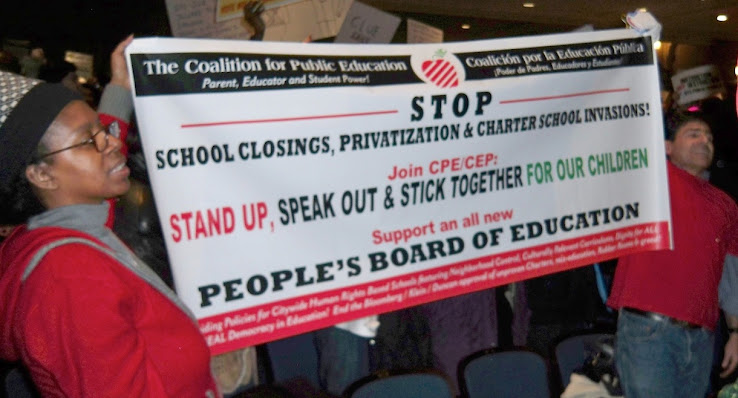
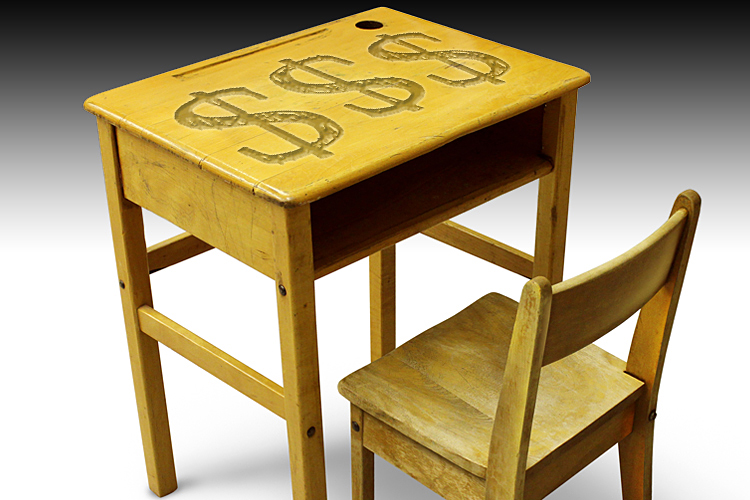
“Another charter school has closed,” began a recent article in a Florida paper, leaving 60 students in the lurch – only this time without bothering to tell district officials beforehand.
In Ohio, at least 15 charter schools have abruptly closed this year – most don’t even bother to list a reason.
In Detroit,
a city wracked by debt and bankruptcy, officials scrambled to close a
failed charter school by Oct. 31 this year, due to the school’s debts,
which exceeded $400,000.
According to The Washington Post, Washington, D.C., spent over $1 million on closing failed charter schools from 2008-2012.
More cities are following the lead of districts like Chicago,
where the largest shutdown of public schools in the nation’s history
occurred at the very same time that new private charter schools were
being expanded by the district.
Abruptly opening and
closing schools – leaving school children, parents and communities in
the lurch and taxpayers holding the bag – is not a matter of
happenstance. It’s by design.
The design in mind, of
course, is being called a “market.” Parents and taxpayers who used to
rely on having public schools as anchor institutions in their
communities – much like they rely on fire and police stations, parks and
rec centers, and the town hall – are being told that the education of
children is now subject to the whims of “the market.”
The
supposed benefit to all this is that parents get a “choice” about where
they send their children to school. But while parents are pushed to
pick their schools on the increasingly turbulent bazaar of “choice,” the
game resembles much less a level playing field and much more a game of
chance in which the house rules determine the odds. And too many of the
nation’s families – and their communities – are getting caught up in a
crapshoot with our children’s education at stake.
Whether
from charters or voucher-funded private schools, the explosive growth
of crapshoot schools is fast becoming the norm. And too few are asking,
“At what risks?”
Welcome to the charter churn
For years, public schools have been admonished to run their operations “more like a business.”
Politicians
on the right and left have criticized pubic education for being a
“monopoly” that is not subjected to enough “competition” in the
“market.”
It is primarily this business thinking that is
behind the push for public education to provide more “choice.” So now
superintendents are calling themselves CEOs, and parents are being
called customers.
But the questions no one ever seems to ask are, “What kind of business? And don’t most businesses fail?”
Nevertheless,
the “business drivers” in education have rolled out, and essential to
this line of thinking is that charter schools provide the necessary
competition the public school monopoly has lacked, and the “churn” of
children in the system will determine which schools stay open and which
ones close.
Since when did children become “churn?”
Businesses
that operate on a subscriber model, such as telephone companies and
credit card providers, are deeply knowledgeable about the rate at which
their customers flow into and out of their billing systems. By knowing
the “churn rate”
these businesses can manipulate the “lifetime value” of customers by
knowing when to goose the system with incentives or extract higher
revenues when demand is running high.
This faith in
churn rate is behind the movement for expanding charter schools. Writing
at his blog at the education trade newspaper Education Week,
teacher and edu-blogger Anthony Cody recently observed, “Charter
supporters are now advocating that charter schools that are not
producing results must be closed with the same ruthlessness as
traditional public schools … This is how markets function … We don’t
need to wait long to find out if schools are ‘good’ or ‘bad.’ These
judgments should be made fast, and acted upon immediately.”
Leading
charter school advocates tell us, in fact, that closing charters down
and interrupting more children’s education is a really good thing.
Little
regard seems to be given to the data that charter schools have proven
to be not particularly any better than traditional public schools. The most recent comparison
of charter school performance to traditional public schools nationwide
found that more charter schools are doing better than they were
previously. But a careful analysis of the study showed only “a tiny real impact on the part of charter schools.”
And
the only real way to improve the overall quality of charter schools
seems to be to close more of them down. How is this good for children
attending those schools?
“This whole strategy of school
reform is having devastating results,” Cody concluded. “Neighborhood
schools, especially those in African American and Latino communities,
are being closed rapidly and without recourse.” Even “worthwhile charter
schools such as ACE Leadership High School in Albuquerque,
which actively recruits drop-outs and struggling students, are likely
to fall under the club, because they may not produce the rapid test
score gains this burn and churn reform strategy demands.”
And increasingly the result is parents taking a chance in a craps game not altogether of their choosing.
Vouchers: A ticket to take a chance
If
families aren’t being subjected to churn from competitive charters on
the one side, they are increasingly being lured with voucher money on
the other.
Giving parents vouchers and telling them to
shop for a school on the private market, often risking taxpayer money
and their children’s future, is another rapidly growing trend in the new
“education market.”
Writing at Americans United,
Simon Brown explained, “More states than ever are piling onto the
‘school choice’ bandwagon. In 2013 alone, 15 states either expanded or
created voucher or ‘neo-voucher’ programs – a system of generous tax
credits that are vouchers by another name.”
Again, much
like the charter crapshoot, parents are told to take their chances in an
open market rather than rely on local schools and trained professional
teachers in a regulated program of learning.
One such state to take up this game of chance is North Carolina. Writing for NC Policy Watch,
Lindsay Wagner recently reported, “For the first time in its history,
North Carolina will allow taxpayer funds to go to largely unaccountable
private schools, 70 percent of which are religious institutions.”
What’s
not required of these private schools would set off alarm bells in most
parents’ minds: “Criminal background checks, any kind of curricular
goals or guidelines, credentialed and/or licensed teaching staff, and a
requirement to reflect the racial and ethnic demographics of the
district in the student.”
A lone state regulator is
responsible for conducting site visits to all 698 of these private
schools. “I try to get out to all of them once every three years,” he
told Wagner, which amounts to roughly 233 school visits each year across
the state.
Further, these private schools, which are
receiving taxpayer money and the faith of parents who want to do what’s
best for their children, are not subject to the same standards that
public schools have for testing students’ academic achievement and
making that data publicly available.
Instead of the raft of tests
N.C. public schools are subjected to, private schools receiving school
vouchers need only to “administer a nationally-recognized standardized
test” that can be “any exam,” so long as the score can be compared to
children in taking the same test in any other state.
Wagner
looked closely at some of these schools. One, New City Christian School
in Asheville, touted its ability to close the “achievement gap” between
white and African-American students but provided parents with no “truly
comparable” way to compare New City’s performance to local schools.
Another
school, Bethel Christian Academy in Kinston, “provides its students
with an educational program that in its entirety, exalts and glorifies
the Lord Jesus Christ by making Him the center of all things.”
The
school uses textbooks that are “God-centered,” and Wagner observed,
“teach students Bible-based facts, including the following: dinosaurs
and humans co-existed on Earth; slave-masters generally treated their
slaves well; in some areas, the KKK fought the decline in morality by
using the sign of the cross; and gay people have no more claims to
special rights than child molesters or rapists.”
“If you
are a gay student or interested in listening to or creating secular
music,” noted Wagner, “that’s grounds for expulsion.”
How
are parents, with children to educate, and citizens, who want to direct
tax money toward the best interests of children, supposed to judge the
“value” of these schools?
When Wagner approached public officials with the question, “Where’s the accountability?” here is what she heard:
Rep.
Marcus Brandon, a proponent of vouchers, told NC Policy Watch, “parents
know what’s best for their children. If it’s a good school, parents
will go there. And if it’s bad, parents won’t … The schools already have
the accountability you could demand of a school because they work in
the free enterprise system. If they don’t pride the product that meets
the needs of the parents, those parents will vote with their feet … I
had 38 schools close this year because they didn’t have the financial
adequance to continue,” he added.
Where did the students
go? “They dispersed and went to other schools. We don’t keep those
records,” a North Carolina schools official said.
In
other words, entrusting education to a voucher-driven market is mostly
“a guessing game,” Wagner concluded – a “guessing game” perhaps for
taxpayers, whose main risks are bad policy and wasted resources – but a
whole lot worse for the parents and students involved whose failed
gamble on a crapshoot school can cost an entire year of learning or
more.
Shouldn’t a responsible society do something to prevent that?
The national pursuit to gamble with our children’s future
North Carolina is hardly alone in this roll out of crapshoot voucher schools.
Even traditional
public schools are increasingly at risk to a crapshoot game of being
opened and closed regardless of the effects on students.
In New York City, as Juan Gonzales recently reported in The Daily News, “the mayor’s relentless rush to shutter neighborhood schools” seems to be the chosen remedy for somehow improving them.
To
local administrators, “shutting down a school and reopening it under
new management is just good business practice. But to parents, teachers
and students, our local schools are the anchors to our neighborhoods.
They are part of the fabric of community life. The local art or gym
teacher is known by and appreciated by everyone.”
Indeed,
Secretary of Education Arne Duncan has done much to contribute to the
spread of crapshoot schools. The very schools he was instrumental in
creating when he ran the system in Chicago are now some of the schools
being shut down, a local Chicago news source recently informed.
This
incoherence coming from the nation’s leadership leaves parents with the
feeling they are “part of one big experiment,” the reporter of that
story noted.
“Sometimes I think that we are all pieces
in the game that they’re playing,” another parent said. “And the game
doesn’t affect their lives. It affects our lives. It affects our
children’s lives and the outcomes of their lives.”
Echoing this sentiment, Noah Berlatsky, writing at The Atlantic,
explained, “Closings are only the latest example of a pattern of
‘reform’ and churn, in which neighborhoods without the resources or
political clout to defend themselves are reorganized and experimented
on.”
The alternative to crapshoot schools
Another
way of running schools, as Gonzales noted, is that you don’t close the
school down when it has problems. “If a school is underperforming, you
add an after-school program. If there are many English-language
learners, you increase language instruction.”
Are we certain that approach doesn’t work?
In
the blog post from Anthony Cody, he noted, schools often do better by
“building a supportive collaborative community” that creates “the
conditions we need in order to grow as teachers, and improve outcomes
for students.”
Parents
are constantly being told of the need for stability in their children’s
lives. Are we now somehow to believe that their educational lives don’t
need that stability too? Rather than being a solution for anything, the
proliferation of crapshoot schools and the mindset that drives them are
becoming yet another very big problem, and one our children and our
communities would all be a lot better off without.